What is waste management?
11. Recover
Similar to the nutrient recovery process of composting, or energy recovery in biogas digestion, energy can also be recovered directly by using dry organic matter like corn cobs, wood shavings, scrap lumber, coconut, peanut or macadamia shells, dried mango seeds, etc. as fuel for burners e.g. to run dryers. They can also be charred and made into briquettes. This can reduce fuel cost in heat or fuel consuming operations.
Samllscale briquette making
Carbonization process using the top-lit kiln design:
(a) The main kiln has an open top and many small holes at the bottom. The adapter has an alternatingly ridged/grooved bottom (b) as well as a star-shaped opening at the top (c). To operate the kiln, first set the biomass on fire from the top (d), and once the fire has spread all around, cover the main kiln with the adapter (e), immediately followed by the chimney (f). After about 20 minutes of pyrolysis followed by about 1-2 hours of cooling, charred biomass is recovered (g).
Smallscale briquette making
Carbonization process using the top-lit kiln design:
(a) The main kiln has an open top and many small holes at the bottom.
The adapter has an alternatingly ridged/grooved bottom (b) as well as a
star-shaped opening at the top (c). To operate the kiln, first set the biomass
on fire from the top (d), and once the fire has spread all around, cover the
main kiln with the adapter (e), immediately followed by the chimney (f). After
about 20 minutes of pyrolysis followed by about 1-2 hours of cooling, charred
biomass is recovered (g).
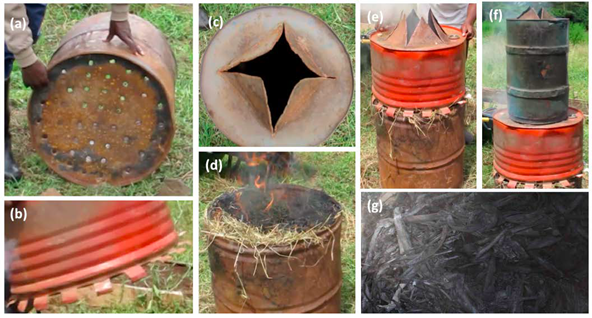
Materials: Obtain two 200-liter oil drums that have sealed bottom and top. Check the drum body so that there are no holes/leaks. One of these two drums will become the main drum, while the other one can be cut in half and made into two separate adapters. In addition, also locate a smaller oil drum with an open end (bottom) and a closed end (top) to serve as the chimney element.
Main kiln: To manufacture the main kiln, cut the top of the 200-liter oil drum open, and open about 20-30 small holes about 5 cm in diameter evenly throughout the bottom of the kiln. Find a metal sheet/cover that can seal the kiln tightly over the top when necessary. This is shown in (a).
Adapter: To manufacture the adapter, cut the other 200-liter oil drum longitudinally into halves. Each half will have an open end (bottom) and a closed end (top). Cut the bottom (open) edge of the kiln into about 10 pairs of alternating ridges/grooves, as shown in (b). Next, cut the top (closed) end of the adapter into an opening through which smoke can be directed, as in (c). Make sure that the opening is smaller enough to fit completely into the chimney piece (to be described below).
Chimney: To manufacture the chimney, cut the top (closed) end of the smaller oil drum into an opening similar to what is shown in (c).
Operating the kiln: Make sure that the ground is even, then elevate the kiln on three rocks about 5 cm above the ground. Load the biomass in alternating easy-to-light and difficult-to-light layers. Make sure that both the bottommost and the topmost layers are easy to light on fire. Once the kiln is filled, evenly light the top of the kiln on fire. Once the fire has spread throughout the kiln, as seen in (d), cover the main kiln with the adapter, followed by the chimney, as shown in (e) and (f). After about 15-20 minutes, the combusting layer (where the heat is located) should migrate from the topmost layer of biomass to the bottommost layer, at which point it is necessary to cover the kiln completely by applying the lid at the top, removing the stones at the bottom, and sealing all possible cracks with sand, as seen in (g). The kiln is then left to cool for 1-2 hours until it is safe to touch the exterior, or if in a hurry, the kiln can be cooled by applying water to it. After the kiln has cooled, the charred biomass can be harvested, ground to fine powder, and briquetted using a press and/or a binding agent.
Author: Kevin Kung