Types of Food Processing Equipment
5. Sterilizers and Pasteurizers
Autoclaves use a combination of steam, pressure and time for sterilization of foods, that is already placed in its heat-proof packaging and placed in the chamber of he autoclave. In order to kill microorganisms and spores effectively, the autoclave must reach and maintain a high temperature of 121°C for at least 30 minutes (depending on the volume and type of the load) by using saturated steam and produce at least 15 psi of pressure.
Batch-Pasteurizers (also called tubular pasteurizers) are mainly used for milk. The milk is held in a double-wall stainless steel vat and agitated with a revolving mixer paddle. First hot water is passed through the double wall, to heat up the milk to 60°C, for 30 min, followed by cold water, to cool the milk down again. The Agitator ensures that all parts of the milk in the vat get in contact with the vat wall for heat (or cold) transfer. The heat can also be provided by hot steam that is blown on the surface of the milk.
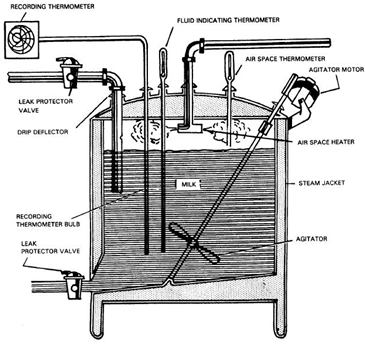 Steam-operated batch pasteurizer
Watch a demonstration of a vat pasteurizer here:
https://www.facebook.com/watch/?v=1786151001437114 Source: Dayspring Dairy
Plate (also called flow, inline, or continuos) pasteurizers, in a continuous flow, pass the liquid product (usually milk, other liquid dairy products, juices, ketchup, etc.) over a heat exchanger plate, which exchanges the heat from hot water, that is flowing in the opposite directing on the other side of the plate. There is no direct contact between the product and the hot water. The pasteurising time is very short to avoid alterations to the product.
Tunnel
pasteurisers differ fundamentally from plate or batch pasteurisers in
that the product in them is in a large number of packaged units rather
than in a bulk. Within a tunnel
pasteuriser the packaged product (like canned beverages) are essembled in a chamber and sprayed with hot water.