Methods of food preservation
6. Smoking
To preserve highly perishable foods like fish and meat, they can be smoked. The preserving effect is a result of the drying of the fish or meat during smoking. The smoke particles that are absorbed by the meat or fish also have a slightly preserving effect as they inhibit bacterial growth, but their main role lies in the favourable effect it has on the taste and color of the food. Smoking is done by exposing food to smoke from burning wood or other materials to add
flavor and preserve it. This is usually done by hanging or placing the food on racks in a chamber designed to contain and supply the smoke and heat of a natural sawdust fire. Hickory or other hardwood sawdust is the preferred fuel. Softwood sawdust, such as of conifers, spruce and pine
contains pitch, which produces a film on the meat and imparts a bitter
taste. Generally, smokehouse temperatures vary from 43°C to 71°C, and smoking periods vary from a few hours to several days, depending on the type of food and its moisture
content. At the higher temperature rannge of above 65°C the smoked food gets cooked, but usually not dried.
Cold smoking at temperatures below 30°C produce and uncooked food, which needs to be kept cold after smoking and has the same short shelf-life as fresh fish or meat. Smoke-drying usually starts with smoldering of damp wood shavings at a temperature of around 45°C, then slowly raising the temperature to about 85°C (by increasing the oxygen flow), where it is cooked for 2-4 hours. Then, the temperature is reduced again to around 50°C and the food left to dry for several hours.
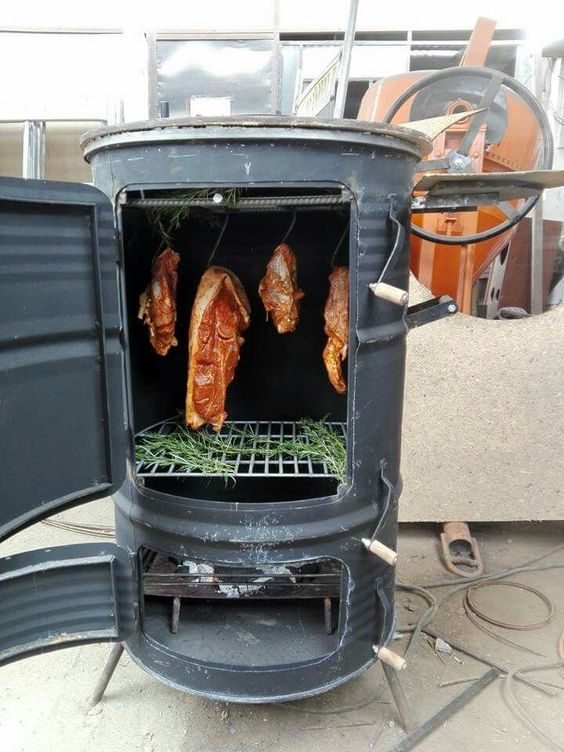
Fresh meat and fish are often brined before smoking. For this, a brine is prepared by boiling 400 - 450 g salt in 5 ltrs of water per each 10 kg of meat. The fish or pieces of meat are placed in a plastic container and topped with the iced or cooled brine. The pieces of fish or meat should freely float in the brine, not be packed tightly. A heavy stone (or similar) is placed on top of the meat or fish to ensure they stay submerged in the brine. Bayleaves, juniper berries and pepper corns, arlic and even sugar can be added to the brine. Leave the meat in the brine to cure for 4 - 5 days, depending on the thickness of the pieces. Thinner pieces get salty faster. During the entire curing time the meat/fish and brine have to be kept cold.
Traditional smoked foods are sausages, cured pork cuts,
like bacon and belly, beef briskets, fish, or cheese. Even speciality
smoked tea, spices, and beverages, etc. are traditionally produced.