Packaging methods and equipment
5. Automatic baggers and bottlers
Baggers are used to fill loose product like flour, tea, nuts, etc. into bags. Automatic baggers have an in-built weighing scale and fill set amounts per bag.
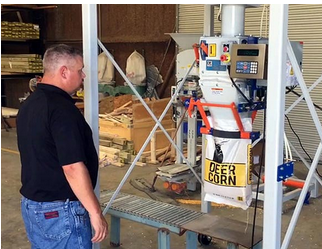 Image source: https://www.tinsleycompany.com/equipment-systems/bag-filling/open-mouth-baggers/
Open mouth bagger
Different types of bottling machines
Bottling machinery selection is driven by your product characteristics, viscosity being the primary factor to consider. Peanut butter for example has a very different viscosity from passionfruit juice and requires a different type of bottling equipment.
There are four different bottling technologies, piston, timed flow, metered flow, and overflow. Peanut butter is best handled by a piston filler that keeps the product warm and therefore at a lower viscosity, all driven by a strong pneumatic cylinder that can fill different quantities of product into a glass or plastic container. Passionfruit juice, on the other hand can be gravity fed into an overflow filler. Overflow filling machines are used for liquids that need to be filled into bottles at the same visual level. Other bottling equipment (e.g. for oils) are timed flow and metered flow bottling machines.
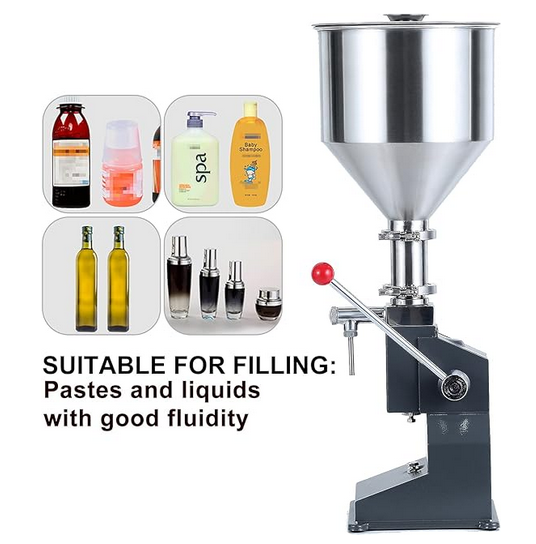 Image source: Amazon
Manual liquid or paste filling machine for small quantities.
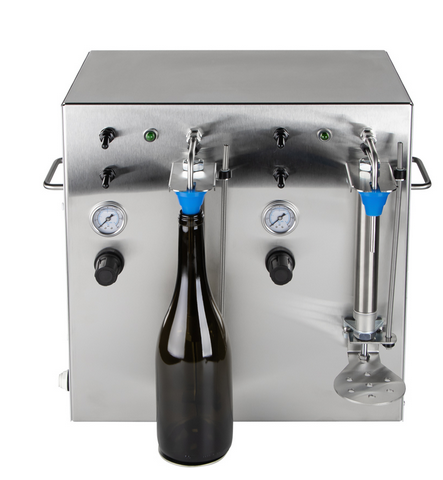 Image source: https://www.xpressfill.com/carbonated-beverage-counter-pressure-bottle-filler.shtml
Smallscale counter pressure bottle filler for carbonated beverages
As a business starts and expands, the needed production rates from their bottling system increases. A startup company’s first machine will typically be a simple bottling machine that may fill a single plastic or glass bottle at a time with an operator handling the containers before and after filling. Increasing the number of nozzles on a bottling system increases production rates and thus the type of bottling machine from semi-automatic to fully automatic. Bottling systems that process glass or plastic containers have as many as twelve nozzles filling at the same time are not uncommon. In these filling systems, a conveyor belt moves the containers under the nozzles, pauses while the liquid fills the bottles, and then moves the filled containers out.