Requirements for food labels
4. Ingredient list
The ingredient list is in most cases displayed on the side of the product, above, below, or beside the nutritional information.
Within an ingredients list, all ingredients must be listed in descending order of ingoing weight. However, in many countries, if an ingredient makes up less than 5% of the food, it does not have to be listed. Some ingredients used in foods are called ‘compound ingredients’. These are ingredients made by a mixture of other ingredients. For example, chocolate (cocoa, cocoa butter, sugar) or pasta (flour, egg, water) unless the compound ingredient makes up less than 5% of the product, then it can just be listed as the compound ingredient rather than all of its own ingredients. This 5% rule does not apply to any additive or allergen, including if they are part of a compound ingredient – these must be listed no matter how small the amount.
Water usually must be declared as an ingredient if it makes up 5% or more of the finished product. However, this doesn’t apply to water that is intended to be drained away such as corn in brine, or if water has been used to rehydrate a dried or powdered ingredient in the product.
Allergens are marked in bold letters.
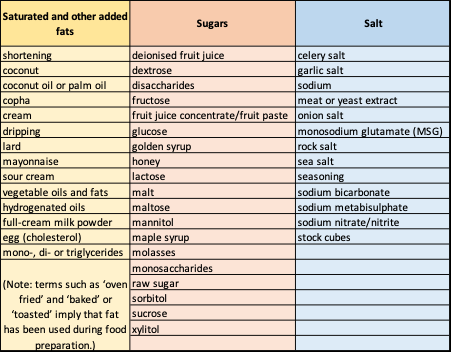
Many customers nowadays want to lower their intake of saturated fats, salt, and sugar. To "hide" these, manufacturers can list the different ingredients used in the product, instead of labeling these as fats, sugars and salt: