Types of Food Processing Equipment
| Site: | Plattform für Weiterbildung und Internationalisierung der Hochschule Weihenstephan-Triesdorf |
| Course: | Entrepreneurship in Food |
| Book: | Types of Food Processing Equipment |
| Printed by: | Gast |
| Date: | Sunday, 26 July 2026, 4:55 AM |
Description

A large reference library of food processing videos, which show a number of different food processing machines and equipment csan be found under resources here.
1. Introduction
Food processing equipment encompasses a large variety of different machinery, tools and equipment. It starts with simple knifes (if you are interested in the different types of knifes and their uses, read this blog by the escoffier school of culinary arts.), chopping boards, which should be colour coded for different locations or uses, and ends with fully automated processing lines.
At the beginning of food processing you will often find a grading or washing line to make sure fruits or vegetabls enter the production area in a good state.
It is important to choose professional equipment that matches your processing needs in size, capacity, required strengths or gentleness, speed, etc. to meet your product specifications and to ensure sfae and easy working conditions with as little downtime as possible. In many cases it might be worthwhile to contact a smallscale equipment producer to get good advice before making the wrong purchase. To make the right choice it is also important to know how the different types of equipment work. Some major types of different equipment types will be describes in the following chapters.
As professional, commercial quality food processing equipment can be very expensive, it might be wothwhile for a start-up to search for refurbished used equipment, like here.
2. Mixers and blenders
- Ribbon Benders — use helical ribbons and can accommodate larger batch sizes. They are very versatile and cost efficient.
- Vertical Blenders — are cone shaped and designed for vacuum operations. These blenders are easy to clean, are gentler than horizontal blenders, and have virtually 100% discharge.
- Tumble Blenders — are double-cone shaped and rotate on a horizontal axis. These blenders are generally used for precise blends and thorough blending of powders.
- Paddle Blenders — These blenders use multiple paddles as agitators and accommodate larger batch sizes. They also have very low shear and generate very minimal heat.
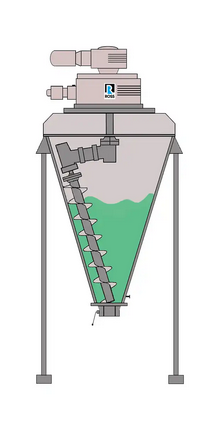 Vertical blender. Image source: Charles Ross & Son Company.
 3. Grinders, mincers
Grinders, also called mincers, are used for a variety of ingredients like meat, fish, dried herbs or chillis, or a mixture of ingredients. In a grinder the food is fed into a cone-shaped metal tube via a funnel on top and moved through the tube by a cone-shaped screw. At the end of the tube it is pressed against a metal plate with holes in it. A metal blade shears of the food, which is pressed through the holes, thereby cutting it into a paste. Depending on the size of the holes the paste (or powder for dry ingredients) can be rough to very fine:
- a fine mesh (Ø 2.7 – 3 mm) is perfect for grinding small seeds but not very suitable for meat.
- holes with a Ø of 4 - 6 mm are suitable for meat, cheese and vegetables
- holes larger than 7 mm are suitable for sausage meat.
Examples:
- juicy, soft meat - 800-watt
- tender meats - 1000- 1,500 watts
- hard meats - 1,600 watts or more
4. Slicers, choppers, cutters and dicers
Slicers , choppers, cutters and dicers can be manual or motor-driven. The choice for either depends on the quantities of material that need to be processed in a day.
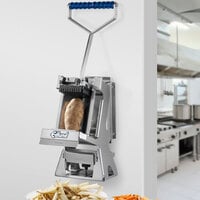 Potato chips cutter with a fixed blade.
These kinds of equipment work by pressing the food against a blade, which can be fixed, moving, or rotating. The blade can be smooth, toothed, serrated, and so on. Another difference can be made by the angle at which the blade and food meet.
Mandoline slicers have a fixed blade and move the food accross the blade.
Bowl cutters are mostly used for cutting meat into a fine paste, e.g. for sausage making. The work by turning the food in a bowl agains a rotating blade.
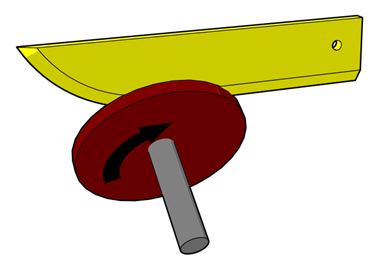
fixed, smooth blade presses against a rotating food press at a slant.
The thickness or diameter of the cut pieces can be adjusted by changing the blade type or changing the distance of the blade from the food.
A large variety of specialized blades are available for variety of uses.
The slide show below gives you an idea of different balde and cutter types. Hover the mouse over each image to read its description.
5. Sterilizers and Pasteurizers
Autoclaves use a combination of steam, pressure and time for sterilization of foods, that is already placed in its heat-proof packaging and placed in the chamber of he autoclave. In order to kill microorganisms and spores effectively, the autoclave must reach and maintain a high temperature of 121°C for at least 30 minutes (depending on the volume and type of the load) by using saturated steam and produce at least 15 psi of pressure.
Batch-Pasteurizers (also called tubular pasteurizers) are mainly used for milk. The milk is held in a double-wall stainless steel vat and agitated with a revolving mixer paddle. First hot water is passed through the double wall, to heat up the milk to 60°C, for 30 min, followed by cold water, to cool the milk down again. The Agitator ensures that all parts of the milk in the vat get in contact with the vat wall for heat (or cold) transfer. The heat can also be provided by hot steam that is blown on the surface of the milk.
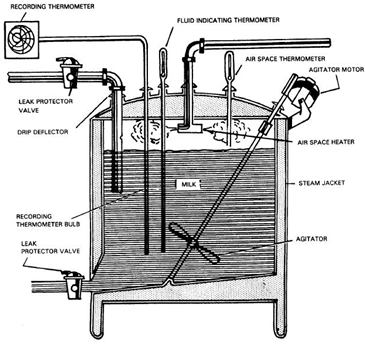 Steam-operated batch pasteurizer
Watch a demonstration of a vat pasteurizer here:
https://www.facebook.com/watch/?v=1786151001437114 Source: Dayspring Dairy
Plate (also called flow, inline, or continuos) pasteurizers, in a continuous flow, pass the liquid product (usually milk, other liquid dairy products, juices, ketchup, etc.) over a heat exchanger plate, which exchanges the heat from hot water, that is flowing in the opposite directing on the other side of the plate. There is no direct contact between the product and the hot water. The pasteurising time is very short to avoid alterations to the product.
Tunnel
pasteurisers differ fundamentally from plate or batch pasteurisers in
that the product in them is in a large number of packaged units rather
than in a bulk. Within a tunnel
pasteuriser the packaged product (like canned beverages) are essembled in a chamber and sprayed with hot water.
5.1. Video: Autoclave explained
Source: https://youtu.be/o1OTjpi4qYw
5.2. Video: Plate type pasteurizer
Source: https://youtu.be/3SfmIJb8VaI
5.3. Video: Tunnel pasteurizer explained
Source: https://youtu.be/f4cBMeCVrGA
6. Dryers
Are you curious how many different types of dryers could possibly exist? If yes, check out this website:https://www.directindustry.com/industrial-manufacturer/dryer-food-industry-109439.html
What we usually refer to as dryers in the food industry however, is equipment like these:
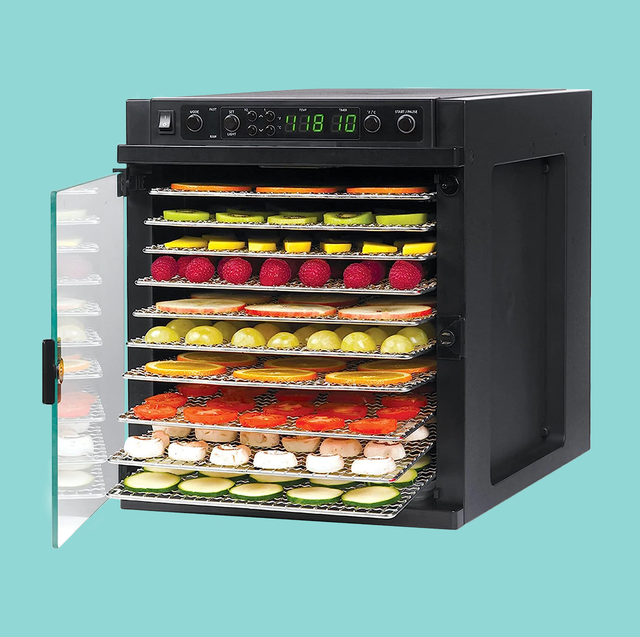 Image source: Tribest Sedona Express, Amazon
or industrial units like this one:
If you do not want to use sulphurization or addition of ascorbic acid for preservation, you might need to consider a closed system, which does not bring your dried products into contact with ambient air.
The use of solar dryers for smaller quantities is also possible. Find the instructions for constructing a solar dryer here.
7. Fryers, cookers, steamers and ovens
Deep frying is a
method of cooking by submerging food into oil at high heat (177 to 191 °C). In the food industry this can be done manually, like for french fries/potato chips, but also with continuous conveyer systems, as used for many fried snacks, many extruded products, or breaded pre-cooked foods. A newer invention are air fryers, which produce healthier, fat-reduced fried foods.
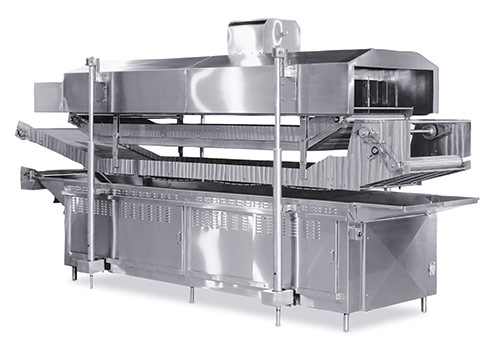
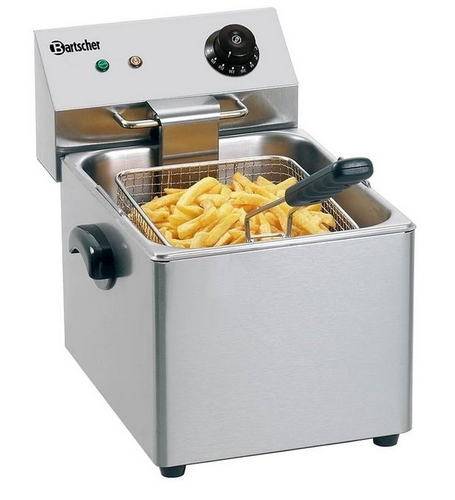
conveyer fryer conventional deep fryer
Image source: mastermatic-prepared-foods-fryer Image source: gastro-hero.de/Bartscher-Fritteuse
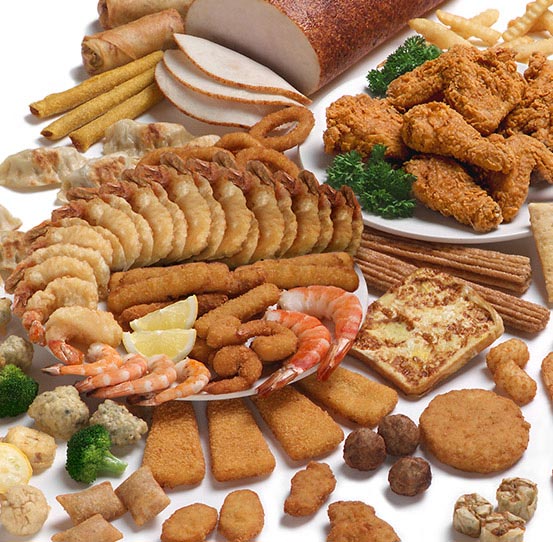
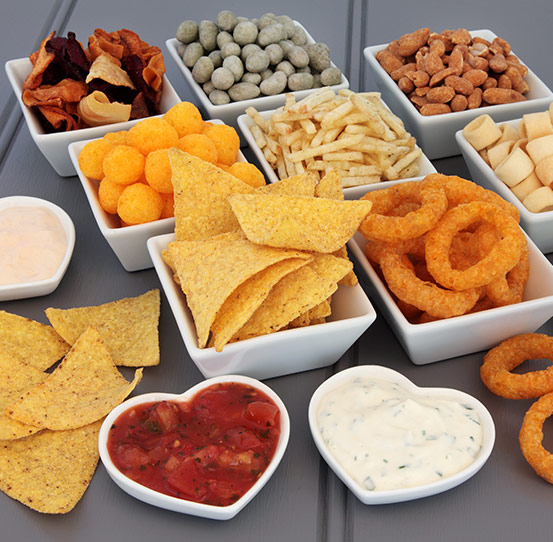 Variety of deep-fried foods & snacks
Cookers are most often used in the production of semi-liquid bulk poducts like syrup or jam.
These kinds of cookers allow for several processing steps, like cooking, concentrating/thickening and pasteurization of the product. Vacuum cookers reduce cooking time and allow for lower cooking temperatures.
In canteens these kinds of cookers are also used to prepare large batches of rice or boiled potatoes e.g.
Meat etc. can be fried in different kind of cookers, like non-stick contact belt cookers, where the meat is passed on heated conveyer belts, which allow for oil-free, gentle frying.
Steamers are a typical piece of equipment in foodservice operation for cooking vegetables, seafood,
potatoes and rice because this equipment usually provides fast
production and helps the food retain moisture, nutrients and color. Some units utilize pressure, others only work with hot steam.
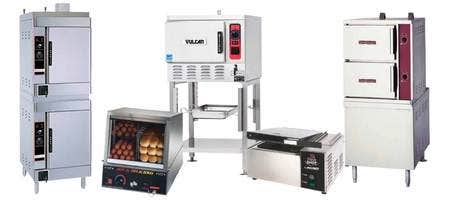 Variety of commercial food steamers
Image source: https://www.equippers.com/media/wysiwyg/L2_steamers.jpg
Ovens are the most important piece of equipment in the baking industry. Original wood-fired oven models with a stone floor and dome roof are still in use today, e.g in artisan bread baking and as pizza ovens. Modern versions are metal chambers, which are heated by gas or oil burners or electricty, where the convected heat bakes the product. These can contain several racks/shelves for larger batches, consist of a hot rotating disk (used in pizza pre-baking e.g.) or even be constructed as a tunnel, where the goods are baked on a conveyer belt.
Ovens are also used to cure meat products like salami and beef jerky.
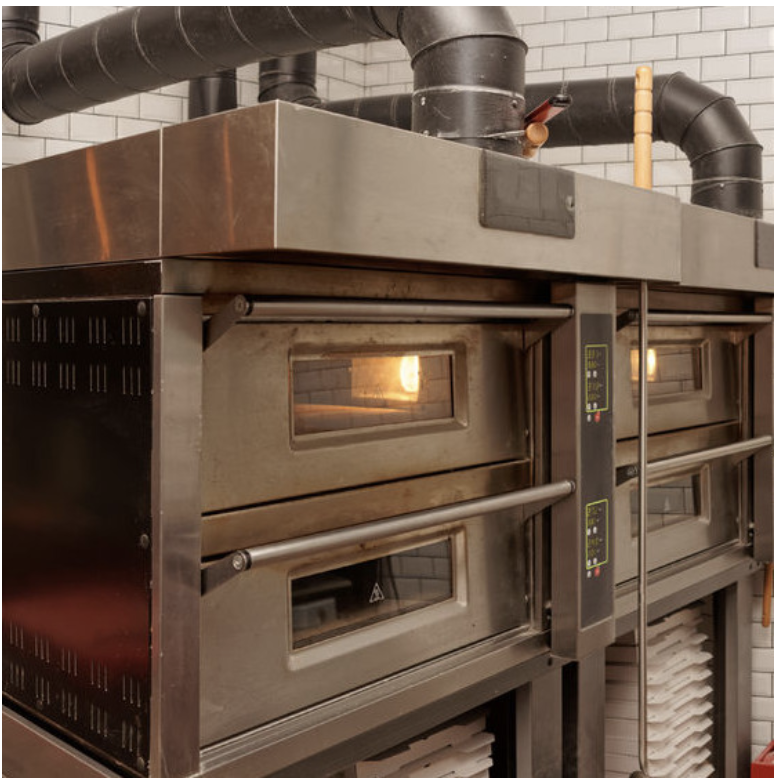 Typical oven in a bakery
Image source: https://bakerpedia.com/processes/oven/
Microwave technology is used in the food industry where frozen food needs to be thawed, loose, granular products such as grains, peanuts, cereals, pulses, or seeds need to be dried, or where the the cooked product (usually pulps/purees, meat or seafood) needs to be pasteurized or sterilized.
8. Extruders
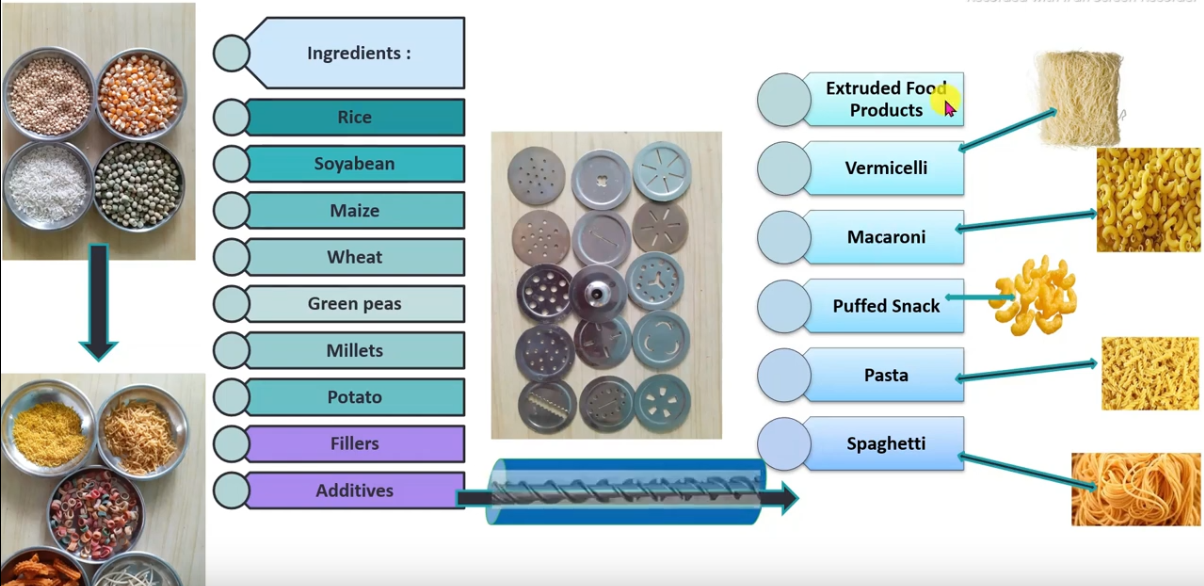
In extrusion cooking a mix of ingedients (usually a flour and water) are forced under pressure and heat through a metal barrel and out through a shaped hole in a metal plate (called a die). The process considerably changes texture and nature of the original ingredient, and gives it a new shape. The resulting product is then cut into shape and sometimes baked or dried afterwards. Although there are piston and roller-type extruders, the most often used type of extruder in the food industry is the screw extruders, which can propel the pasty product forward with a single screw or twin screws.
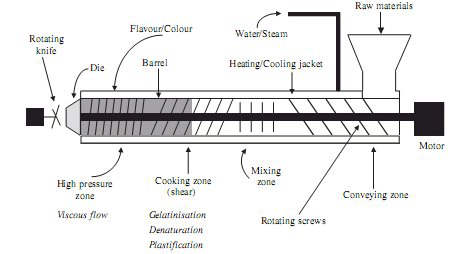
Schematic representation of food extrusion cooking process
Image source: Oonsivilai, Anant & Oonsivilai, Ratchadaporn. (2008). Parameter estimation of frequency response twin-screw food extrusion process using genetic algorithms. WSEAS TRANSACTIONS on SYSTEMS. 7. 1207-1217.