Packaging methods and equipment
| Site: | Plattform für Weiterbildung und Internationalisierung der Hochschule Weihenstephan-Triesdorf |
| Course: | Entrepreneurship in Food |
| Book: | Packaging methods and equipment |
| Printed by: | Gast |
| Date: | Sunday, 26 July 2026, 4:03 AM |
Description

1. Weighing scales
Weighing is an essential part of the entire food production process, starting with weighing of received raw materials, then weighing ingredients to fulfill recipe specifications and quality requirements, all the way to the weighing and labelling of finished product during packing. Accurate, high-quality food scales help processors adhere to production requirements and reduce the risk of creating out-of-spec product., which can jeopardize the health of consumers and subject processors to fees for non-compliance with foodservice regulations. When selecting a weighing scale make sure it is simple-to-install and can easily integrate with computers, label printers and scanners where needed.
Types of scales used in the food processing industry:
Floor Scales
Floor scales are most often used on receiving docks to weigh incoming pallets or crates of raw materials to record delivered quantities. They are built into the floor so that heavy lifting can be avoided. Alternatively crane scales can be used at reception to weigh produce in hanging bags or sacks.
Bench Scales
Bench scales for food processing should be very precise and able to weigh in small units (e.g. gram). Another important factor is good readability, therefore the display should be at a convenient hight and well lit. The weighing table size and shape, as well as the upper weighing range limit needs to match your product.
You can check out various bench scale types here.
Counting Scales
Counting scales allow processors to efficiently weigh a high volume of identical parts. These weighing scales show the total weight as well as the number of pieces that correspond with this weight. This is useful in food production where the same ingredient may be used repeatedly in a batch and ensures the final product is of consistent quality.
Checkweighers
Are useful during sorting/grading procedures as they allow to select a weight range and reject products that do not fall within the set range. This can be useful at the reception stage (e.g. for sorting coconuts by weight), during processing if e.g. e certain filling range for drier crates must not be exceeded, or at the shipping stage, to ensure boxes etc. are filled to specifications.
Conveyor Scales
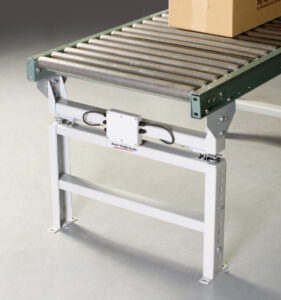 Source: https://www.averyweigh-tronix.com/en-ca/weighing-guides/guide-weighing-in-food-processing-environments/
Where speed and accuracy are needed, conveyor systems improve processing speed and reduce need for lifting. The scale operates while the conveyor is in motion. It can weigh individual boxes, cans or even large pieces of unpackaged product.
Linear weighers
Linear weighers are used to fill loose product like flour, tea, nuts etc. into bags or packages at a certain weight. This is useful for larger throughput production, where weighing in by hand is no longer feasable.
The hand-operated alternative are mechanical gross weigh bagging or open mouth scales, which weigh loose product into bags.
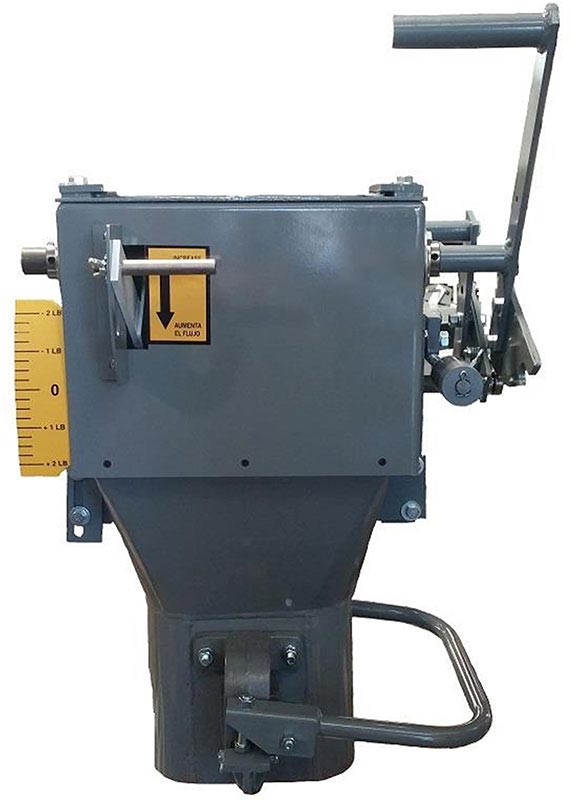
Image source: https://www.tinsleycompany.com/wp-content/uploads/2019/08/deer-corn-bagging-machine-wolverine-mechanical-gross-weigh-scale.jpg
To ensure accuracy of food processing scales, it is important to frequently clean them and to remove food or liquid buildup that may have accumulated. Scales also need to be calibrated regularly by authorized personell to avoid out-of-spec products and legal liabilities.
2. Sealers
Sealers are used to close plastic packaging. They come in different types and sizes depending on the packaging material and shape.
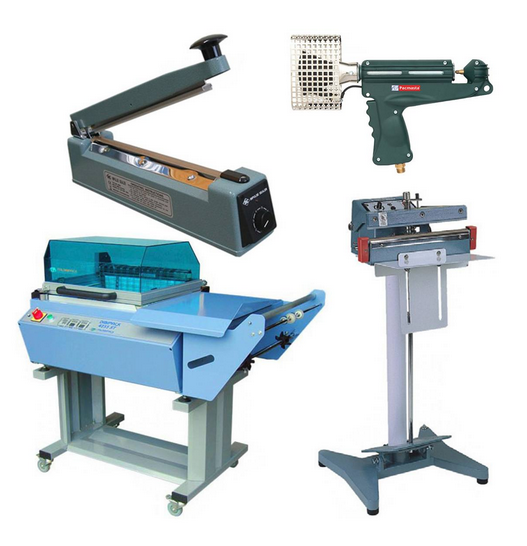
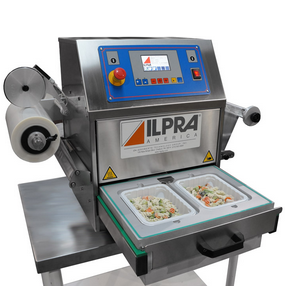
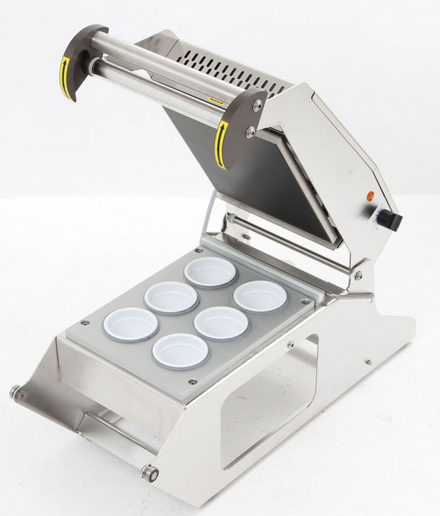
Image Sources: https://packline.com.au/heat-sealers-for-the-food-industry/; https://rtgpkg.com/ilpra-america/ilpra-tray-sealers/; https://www.avedemil.com/en/thermo-sealing-machine
Special sealing equipment is neeeded for sealing bags, pouches, sachets, or tubs, which need a lid. Lids can be plastic film (e.g. for thermo-formed plastic trays) or aluminium lids (e.g. for yoghurt tubs, etc.). Sealers work by welding thermoplastic layers together to form an airtight leak-proof seal. Each material has specific requirements for temperature, pressure and cooling to form such a seal. Therefore, make sure your packaging material and sealing equipment match before making a purchase decision.
There are two types of heat sealers for the food industry. The impulse heat sealer applies heat in short intervals of one to 10 seconds when the jaws that conduct heat are closed on the plastic bag. To complete the sealing an operator pushes down the jaws to heat and melt the thermoplastic layers together. The element then shuts off and the welded area cools quickly to harden the seal.
The second type of sealer is a continuous heat sealer where the heating bar stays continuously hot. Continuous sealers work best for fast-paced sealing jobs with a large volume of sealing to complete. Rotary band sealers have a motorised conveyor belt that feeds the packaging through the constant heat-sealing jaws at a regular speed to create a consistent quality seal. These machines are good for even quality and sterile sealing.
Styles of heat sealers
There are different styles of heat sealer such as a hand-operated sealer requiring an operator to push down a heated lever on the bag to create a weld. There are foot pedal operated sealers that engage the heating bar. Operating a foot pedal frees up the operator’s hands to accurately position the packaging in the sealing jaws. Some models come with a conveyor belt to keep up a fast-paced production line.
Heat sealing machines come in many sizes and methods of application with single heat sealers capable of sealing a few products per day to larger semi-automatic machines for production lines where output is high.
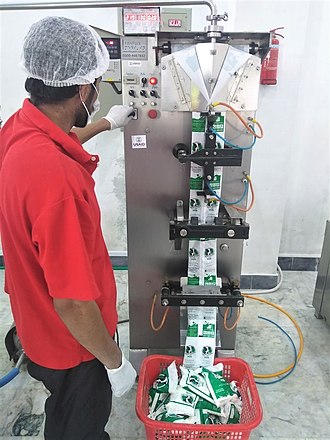 Vertical milk pouch filler-sealer.
Image source: https://upload.wikimedia.org/wikipedia/commons/thumb/8/8f/Milk_bag_packaging_machine.jpg/330px-Milk_bag_packaging_machine.jpg
What size sealer do you need?
Heat sealers come in a variety of widths. As a rule, choose one that is a minimum of 20mm deep and a maximum of 50mm wider than your sealing area. You should make sure your packaging isn’t wider than your heat clamps, so you get a nice neat and straight seal without air pockets and gaps. Also, think about the volume of sealing you need to do per day and choose a machine that will not overheat.
Textured seals
Some heat sealers imprint a textured seal on the packaging. This is called crimping and is good for strengthening the seal and tamper evidence. Textures can come in a crosshatch, corrugated or honeycomb crimping and is often chosen for a professional and aesthetic look to the packet.
Source: https://packline.com.au/heat-sealers-for-the-food-industry/
3. Vacuum skin packaging (VSP)
Vaccum packaging equipment is ideal for all products that deteriorate if in contact with air (oxygen). These are all products that contain fat/oil like nuts or highly perishable products that spoil due to bacteria activity, like fresh meat, cold cuts, cheese, etc. If a product is vaccum packed, no air remains in the package, which means any bacteria on the product can not multiply due to lack of oxygen. Vaccum packaging equipment is basically a sealer, which pumps out the air from the package before sealing.
Different types of vaccum packaging equipment exist, some very simple and low-cost, others allow for bigger batches, continous packing or packing under controlled environment.
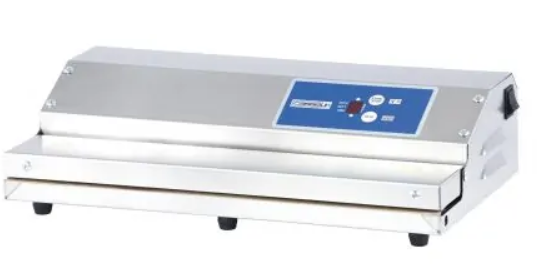 Image source: https://www.casselin.com/gb/17740-vacuum-packing-machine-40-3611630002431.html
Simple tabletop vaccum sealer.
4. Stretch and shrink film wrappers
Stretch wrap or stretch film is a plastic wrap applied by hand or machine to contain boxes and products on pallets to keep them safe during shipping. Stretch wrap comes in many lengths, widths, colors, gauges, and types, depending on your need. Stretch film is applied by hand (hand film) or by equipment (machine film). Machine wrappers can automatically wrap various pallet loads and sizes. Some machine wrappers have an “arm” that rotates around the pallet, while others require the pallet to sit on a platform that spins while the stretch film is applied.
Shrink film is the tight plastic packaging that surrounds consumer goods like water bottles or soda cans which are sold in bundles. This film gets its name from the literal shrinking of the plastic film to package a product. It allows for bundles of products to be sold in one package. Shrink film also allows for increased security and protection, because it is easy to tell when a shrink-wrapped package has been tampered with. It can be printed and branded. Shrink film typically used in the food industry is Polyolefin.
Watch a hooded shrink wrapping machine in action
Source: https://youtu.be/azS1TqVIYoA
Simple handoperated cling film or food wrap dispensers can be used to wrap fresh produce, meat or cheese on food trays. The wrapper ensures that the film does not get entangled. A heated blade cuts the film and the film gets sealed on a heated non-stick plate.
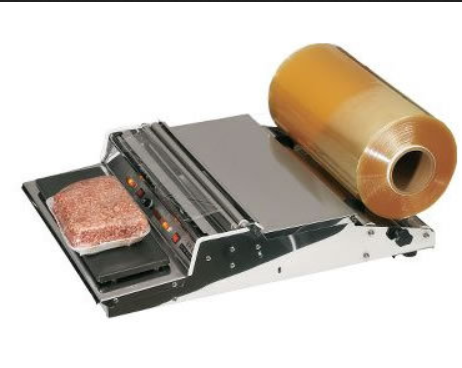 Image source: https://www.getpacked.com.au/assets/full/5-Food-Film-Dispensers.jpg?20210427124037
5. Automatic baggers and bottlers
Baggers are used to fill loose product like flour, tea, nuts, etc. into bags. Automatic baggers have an in-built weighing scale and fill set amounts per bag.
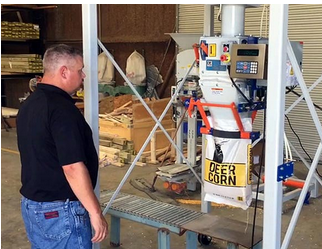 Image source: https://www.tinsleycompany.com/equipment-systems/bag-filling/open-mouth-baggers/
Open mouth bagger
Different types of bottling machines
Bottling machinery selection is driven by your product characteristics, viscosity being the primary factor to consider. Peanut butter for example has a very different viscosity from passionfruit juice and requires a different type of bottling equipment.
There are four different bottling technologies, piston, timed flow, metered flow, and overflow. Peanut butter is best handled by a piston filler that keeps the product warm and therefore at a lower viscosity, all driven by a strong pneumatic cylinder that can fill different quantities of product into a glass or plastic container. Passionfruit juice, on the other hand can be gravity fed into an overflow filler. Overflow filling machines are used for liquids that need to be filled into bottles at the same visual level. Other bottling equipment (e.g. for oils) are timed flow and metered flow bottling machines.
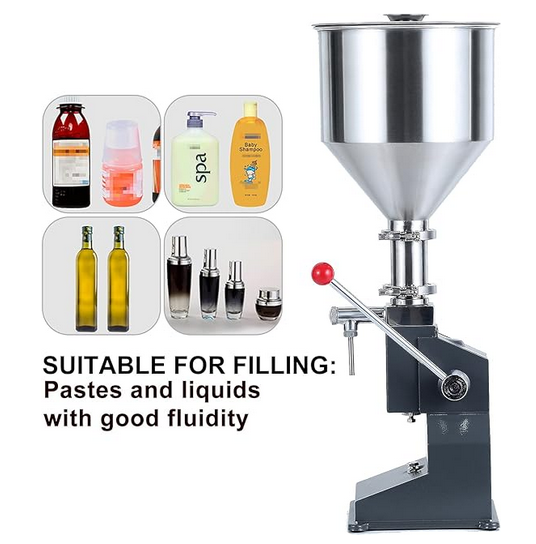 Image source: Amazon
Manual liquid or paste filling machine for small quantities.
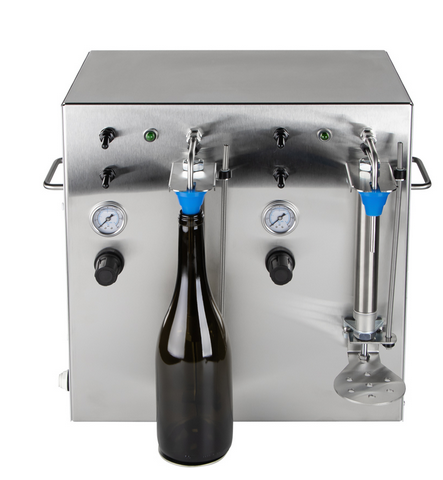 Image source: https://www.xpressfill.com/carbonated-beverage-counter-pressure-bottle-filler.shtml
Smallscale counter pressure bottle filler for carbonated beverages
As a business starts and expands, the needed production rates from their bottling system increases. A startup company’s first machine will typically be a simple bottling machine that may fill a single plastic or glass bottle at a time with an operator handling the containers before and after filling. Increasing the number of nozzles on a bottling system increases production rates and thus the type of bottling machine from semi-automatic to fully automatic. Bottling systems that process glass or plastic containers have as many as twelve nozzles filling at the same time are not uncommon. In these filling systems, a conveyor belt moves the containers under the nozzles, pauses while the liquid fills the bottles, and then moves the filled containers out.
6. Modified atmosphere packaging (MAP)
Modified atmosphere packaging (MAP) is the addition of a gas, typically nitrogen (N2) mixed with carbon dioxide (CO2), into seal-packaged food products to extend the shelf life and to preserve the freshness of fresh-cut processed fruits and vegetables, nonfrozen chilled meats/fish/poultry, ready-to-eat meals, and semiprocessed bulk foods by controlling their microbial activity and oxidation of the product. If the storage temperature is adequsate, MAP packaged fresh foods do not require the addition of chemical preservatives or stabilizers. The high cost of gas packaging machinery and need for staff training limits the use of MAP for small-scale production.
Watch a video on MAP e