Microorganisms in food
| Site: | Plattform für Weiterbildung und Internationalisierung der Hochschule Weihenstephan-Triesdorf |
| Course: | Entrepreneurship in Food |
| Book: | Microorganisms in food |
| Printed by: | Gast |
| Date: | Sunday, 26 July 2026, 6:48 AM |
Description

1. Introduction
On the other hand many microorganisms in our environment and even in our food are beneficial. They play important roles e.g. in decomposition of organic matter into humus, needed for soil fertility, or populate our gut to keep us healthy. Some are necessary in food processing, like yeasts that raise dough or produce bubbles in beer, or those that culture yoghurt or ferment cabbage into sauerkraut or kimchi, just to mention a few. These beneficial microorganisms are often called 'microbes'.
In this lesson we will take a brief look at both, as it is important for successful and safe food processing to be able to support the 'good ones' and to suppress the 'bad ones'
2. Cause of foodborne illnesses - a data review
According to a data review conducted by the FDA in 2015, viral pathogens
account for an estimated 5.5 million foodborne illnesses each year, with
norovirus responsible for most foodborne illnesses on an annual basis
(58%) (Scallan et al., 2011).
Among
the bacterial pathogens causing foodborne illnesses, the three most
common are Salmonella spp. (11%), Clostridium perfringens (10%) and
Campylobacter spp. (9%) (Scallan et al., 2011). Other bacterial
pathogens causing relatively large numbers of illness include Bacillus
cereus, E. coli O157:H7, non-O157 Shiga-toxin producing E. coli,
Shigella spp., Staphylococcus aureus, and Yersinia enterocolitica
(Scallan et al., 2011).
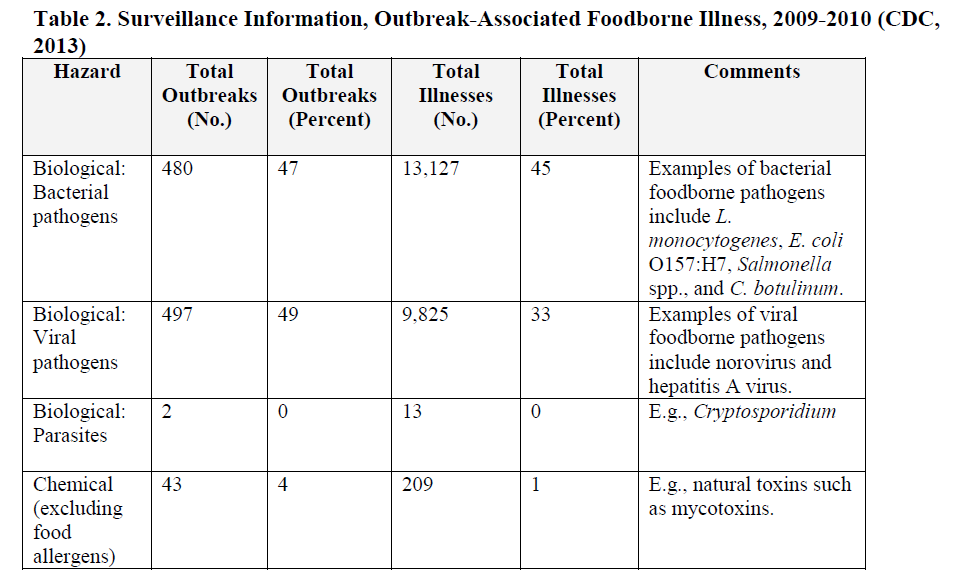
Source: Center for Food Safety and Applied Nutrition, Food and Drug Administration, U.S. Department of Health and Human Services, "Qualitative Risk Assessment: Risk of Activity/Food Combinations for Activities (Outside the Farm Definition) Conducted in a Facility Co-Located on a Farm", 2015
3. Cell types and charcateristics
4. Binary fission
Example:
- the bacteria divide every 20 min
- number of bacteria = 2n (whereby n = the number of rounds of devision)
after 3h (= 180 min): 180/20 = 9 => n = 9 rounds of devision
number of bacteria = 29 => 512 or 5,12 x 10²
after 8 hours (= 480 min): 480/20 = 24 => n = 24 rounds of devision
number of bacteria = 224 => 16,777 216 or 1,678 x 107
Watch the following animation of bacterial growth over the timespan of 8 hours in fullscreen mode:
5. Ideal conditions for bacterial growth
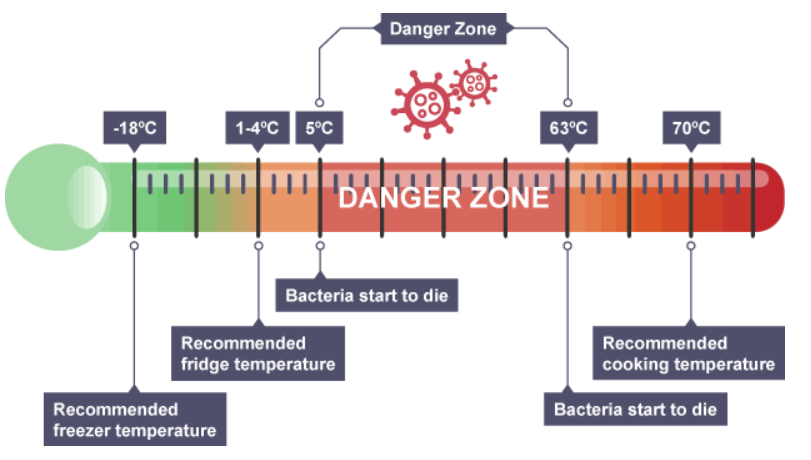
- Warmth – The optimum temperature range for bacterial growth is between 5-63℃. This is known as the danger zone as it is dangerous for some foods to be in this temperature range for prolonged periods of time. Therefore, the temperature a food is stored, prepared and cooked at is crucial. If the cooling and heating regime is not followed correctly, the food might not be safe to eat.
- Moisture – Bacteria need moisture in order to grow. This is why they grow on foods with high moisture content such as chicken. Foods that are dehydrated or freeze-dried can be stored for much longer as the moisture has been removed
- Food – Food, in particular protein, provides energy and nutrients for bacteria to grow. High risk foods are therefore those like chicken and dairy products, which are rich in protein as well as moisture and therefore conducive for bacterial growth
- Suitable pH – Most bacteria reproduce best at a neutral pH level of 7. Acidic foods with a pH below 7, or alkaline foods with a pH above 7, may stop or slow down the rate of bacterial growth.
6. Biofilm creation
Bacteria have the ability to form a biofilm that provides protection from commonly encountered environmental stresses like temperature changes, drying out, and even cleaning measures like scrubbing and use of detergents or sanitizers. Once pathogenic bacteria attach to and accumulate on equipment and surfaces and form biofilms they also have a significantly increased resistance to antimicrobials. This ability makes the existence of harmful bacteria in food processing environments very dangerous. Very likely more than half of all foodborne illnesses are caused by bacterial biofilms. Foodborne pathogens like Salmonella sp., Listeria monocytogenes, Campylobacter jejuni, Escherichia coli O157: H7, Yersinia enterocolitica and Staphylococcus spp. have been reported to form a biofilm in food processing facilities.
Bacterial biofilm formation is a series of dynamic steps, comprised of initial attachment, irreversible attachment, biofilm development, biofilm maturation, and biofilm dispersion. Once bacteria attach to a surface the cells are overlaid by a conditioning film comprising of a small quantity of polysaccharides, proteins, and phospholipids. The attached bacteria continue to produce a polysaccharide to form a microcolony which matures into a biofilm. During the maturation process secreted extracellular polymeric substances (EPS ) help strengthen the bond between the bacteria to stabilize the colony and protect it from any hostile environment. Once the biofilm is formed, bacteria can survive even under very unfavorable conditions. During biofilm maturation, the bacteria develop into an organized flat or mushroom-shaped structure. The final step is a dispersion of the biofilm.
The initial attachment of bacteria to a surface is reversible and the bacterial cells still detach easily. However, the more EPS is produced, the adhesion of the bacterial changes from reversible to irreversible. During this step, the originally weak contact forces change to tight bonding.
The attached material properties and environment (pH, temperature, and nutrients) have an affect on the formation and early development of a biofilm and it is therefore crucial to control and eliminate the formation of biofilms from the start. Frequent meachanical cleaning, like scrubbing with detergents, rinsing with hot water, wiping off residues, etc. can assist in preventing biofilm formation from the start. However, mechanical treatment alone, such as cleaning, cannot remove all bacterial cells and needs to be combined with chemical treatments such as the use of sodium hypochlorite (NaClO) to adequately eliminate bacterial cells and inhibit biofilm formation.
Various other methods have been developed from different aspects, such as inhibition of bacterial adhesion and bacterial detection in the early stage, as well as dissolving the biofilm. New strategies involve biochemical agents including clove and thyme essential oils, enzymes, biosurfactants, and others for “green” approaches to control pathogen biofilms formation.
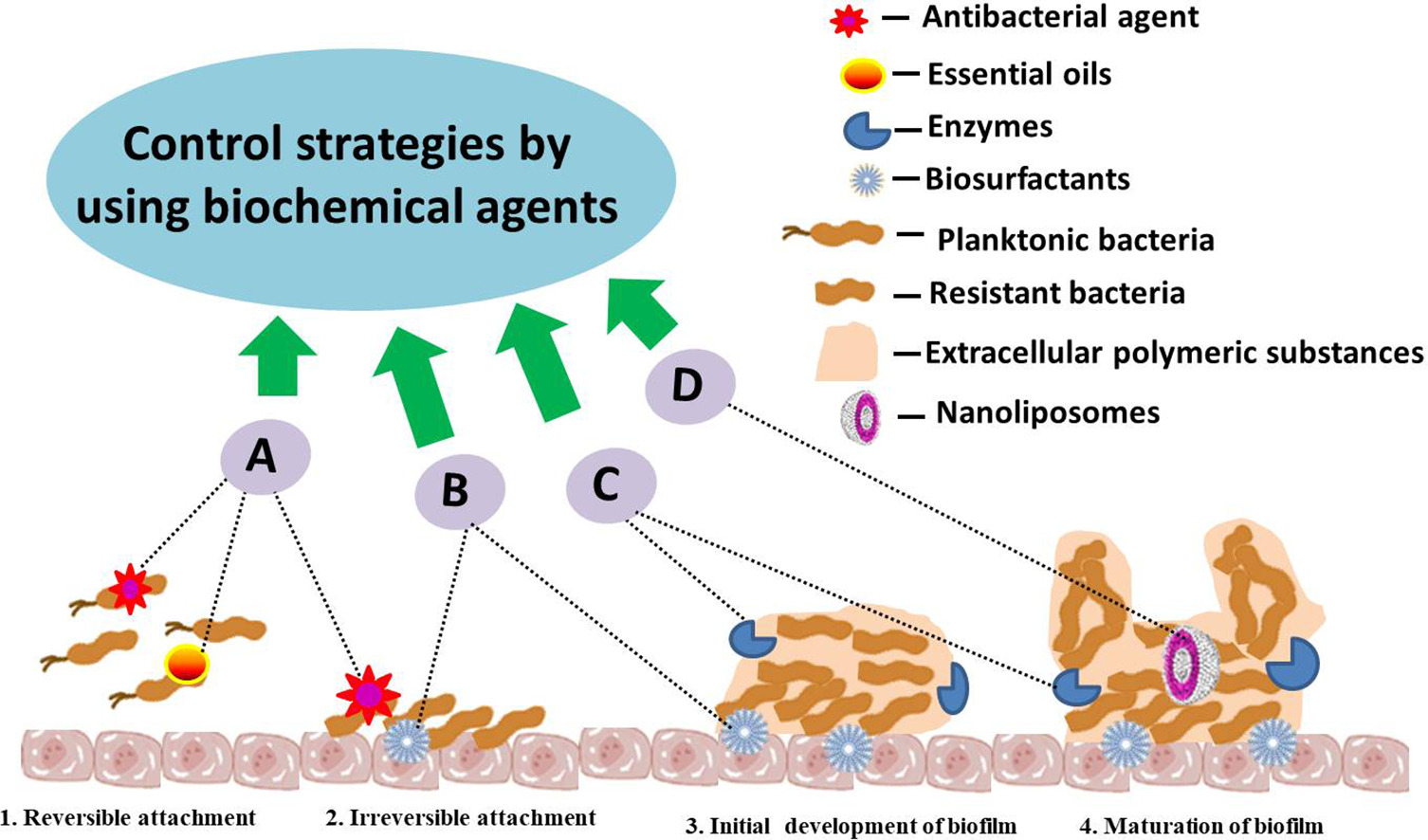
Image source: Tingwei Zhu, et al, Strategies for controlling biofilm formation in food industry, Grain & Oil Science and Technology, Volume 5, Issue 4, 2022,
Find some new research from Wageningne Universtity about 'How Listeria Strains Evolve Into Strong Biofilm Formers' here.
7. Beneficial microorganisms
Besides the harmful microorganisms, mentioned in the earlier chapters, which can spoil food and therefore play an important role in the food industry, there are also a large number of very useful, so-called beneficial microorganisms that are also extremely important in food processing. Since ancient times, these microorganisms have been used to produce a variety of foods, such as bread, dairy products, fermented vegetables, condiments made from fermented seafood or legumes, vinegar, as well as alcoholic beverages. Fermenting in particular is a method to conserve food while increasing its nutrient value. In the glossary you can find references and descriptions to a large number of traditional fermented products.
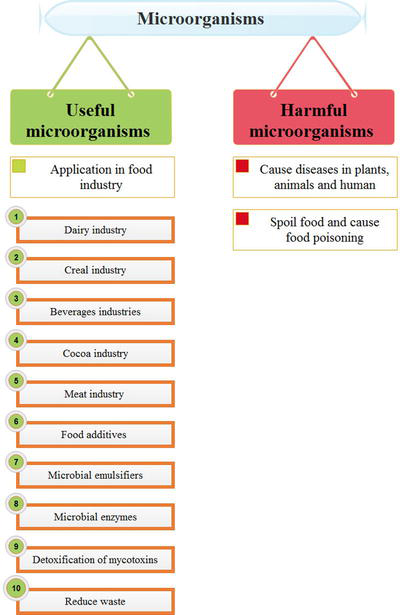
Image source: Mohammadhassan Gholami-Shabani et al, Food Microbiology: Application of Microorganisms in Food Industry, 2023
During these biochemical processes certain types of microorganisms change simple sugars like glucose or lactose into alcohol, different acids, or carbon dioxide via a variety
of metabolic pathways. For example,
8. How cells obtain energy from food
Cells require a constant supply of energy to stay alive. This energy is derived from the chemical bond energy in food molecules, which thereby serve as fuel for cells.
Sugars are particularly important fuel molecules. In a first step all carbohydrates (as well as proteins and fats to a certain degree) are broken down into glucose, which is then in a chain of reactions called glycolysis converted into into two molecules of pyruvate. During pyruvate formation, two types of energy-carrying molecules are produced—ATP and NADH. Some of the steps in this process are triggered by certain enzymes.
The steps following glycolysis depend on the absence or presence of oxygen as well as the presence of either yeasts or lactic acid producing bacteria.
In the presence of Oxygen and yeast the pyruvate produced during glycolysis is rapidly transported into the mitochondria, where it undergoes alcoholic fermentation. In the so-called citric-acid or Krebs cycle, the pyruvate is first converted into CO2 plus acetyl CoA, which is then further converted into products, which are excreted from the cell—for example, into ethanol and CO2 used in brewing and breadmaking. This process yields a considerable amount of energy-carrying molecules, like ATP, as well as GTP, NADH, NADPH and FADH2
Alcoholic fermentation: C6H12O6 --> 2C2H5OH + 2CO2 (Glucose --> Ethanol + Carbondioxide)
In the absence of oxygen, pyrovate will be
turned into lactic acid with the help of lactic acid forming bacteria. These anaerobic
energy-yielding pathways are called lactic acid fermentation,
and yields the NAD+ that is needed to fuel glycolisis.
Lactic acid fermentation: C6H12O6 --> 2CH3-CH(OH)-COOH (Glucose --> Lactic acid)
In a last step the chemical energy is released from the energy-carrying molecules NADH and FADH2, which transfer the electrons that they have gained to specialized electron acceptors in the cell membrane. The electrons released in this process are used to pump H+ ions (protons) across the membrane thereby generating a gradient of H+ ions between the inside and the outside of the cell. This gradient serves as a source of energy, being tapped like a battery to drive a variety of energy-requiring reactions. The most prominent of these reactions is the generation of ATP by the phosphorylation of ADP.
Source: Alberts B, Johnson A, Lewis J, et al., Molecular Biology of the Cell. 4th ed, New York: Garland Science; 2002
I have put together the animation below to illustrate the different steps involved in the process of cells acquiring energy from food.
8.1. Steps of glycolysis and fermentation
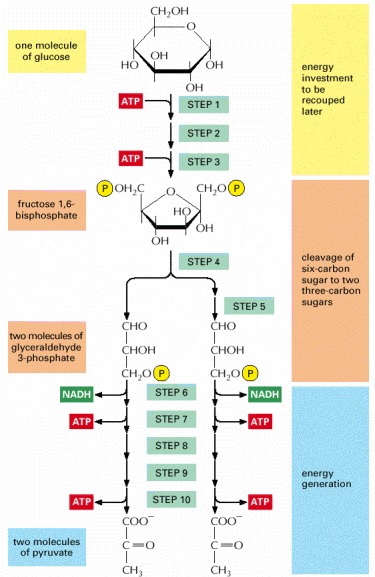
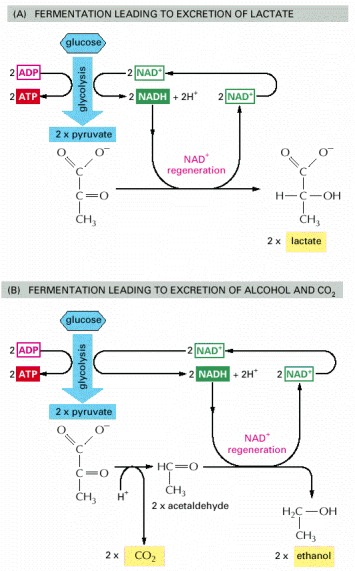
Source: https://www.ncbi.nlm.nih.gov/books/NBK26882/