Lubricants and heat transfer liquids
| Site: | Plattform für Weiterbildung und Internationalisierung der Hochschule Weihenstephan-Triesdorf |
| Course: | Entrepreneurship in Food |
| Book: | Lubricants and heat transfer liquids |
| Printed by: | Gast |
| Date: | Sunday, 26 July 2026, 4:03 AM |
Description

1. Lubricants in food processing equipment
Lubricants reduce friction in mechanical machine parts and are therefore maily used in food processing equipment to provide protection against wear, but also against corrosion and oxidation (rust) and in some cases are even provide a sealing effect. They are also sometimes used to dissipate heat (cooling) and transfer power. These lubricants must be compatible with the rubber and other
sealing materials used in food processing equipment, and be of food-grade quality to prevent harmful contamination of food products.
Lubricants can be in the form of oils or greases.
Oils are usually found in gear transmissions, engines, hydraulic as well as pneumatic systems, and central lubrication systems, Oils are also sometimes used as heat transmission liquid in heat exchangers.
Greases on the other hand, are used in bearings and valves. They
are lubricating oils that have a thickening agent added to the
formulation.
Case study:
In 1998, more than 490,000 pounds of smoked boneless hams were recalled by Smithfield Foods because they were contaminated by a gear lubricant after several customers reported a “bad taste” and “burning in the throat for up to three hours” from eating the ham.
This is just one of a number of examples, where food was contaminated by a lubricant that seaped out from the food processing equipment. Therefore, maintenance of seals, gearboxes, valves, pumps, and moving parts is crucial in food processing, as is the use of foodgrade lubricants, which are safe to ingest, odor-, taste- and colorless. Foodgrade lubricants must also be resistant to degradation when in contact with food products, certain process or cleaning chemicals, hot water or steam, and must not become contaminated by bacteria.
Food-grade lubricants are put into
categories based on the likelihood they will contact food:
H1 lubricants are food-grade lubricants used in food processing
environments where there is some possibility of incidental food contact.
H2 lubricants are lubricants used on equipment and machine parts
in locations where there is no possibility that the lubricant or
lubricated surface contacts food.
H3 lubricants, also known as soluble or edible oil, are used to clean and prevent rust on hooks, trolleys and similar equipment.
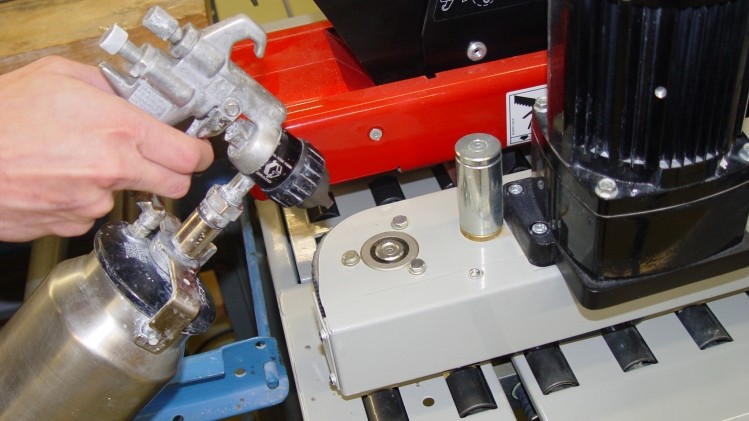
Image source: https://www.bakeryandsnacks.com
2. Heat transfer liquids
Heat transfer fluids are gases or liquids that transfer thermal energy in indirect cooling or heating systems. They are typically confined in a closed circuit and often pumped in continuous cycles.
Water is the most frequently used heat transfer fluid where temperature ranges between 0°C and 100°C are sufficient. However the use of water as a heat transfer liquid is limited by its freezing and evaporation points for temperature ranges below 0°C or above 100°C.
Non-water heat tranfer fluids commonly have a high boiling point and the ability to hold and transfer thermal energy efficiently. Food grade heat transfer liquids are those, which are safe even if they incidentily get in contact with food. They are called HT1 heat transfer liquids.

Image source: https://relatherm.com/
3. Cryogenic processes
Crygenic processes can be used in cooling processes. Three different cooling methods are commonly used:
- contact cooling, whereby block-shaped foods are frosted on metal plates, which are cooled by a cooling liquid
- freezing by cold air, which is blown over and around the food
- cyrogenic methods, where gases like Carbondioxide (-78°C) or Nitrogengas (-196°C) are blown into a tunnel, through which the food passes. Both gases are non-poisonous, odor- and tasteless, and can therefore be used to freeze unpacked foods like fruits, baked goods, meat or fish.
In large cooling facilities ammonia gas is often used to replace the greenhouse gas CFC.

Image credit: Andrea - stock.adobe.com