Agricultural machinery costs calculation 1 - english
| Website: | Plattform für Weiterbildung und Internationalisierung der Hochschule Weihenstephan-Triesdorf |
| Kurs: | International Network in Agricultural Management and Rural Development |
| Buch: | Agricultural machinery costs calculation 1 - english |
| Gedruckt von: | Gast |
| Datum: | Freitag, 25. September 2026, 05:24 |
1. Chapter
Chapter 1: Introduction costs
1.1: Introduction: economics
1.2: Farmers Boris and Alexander have a problem!

What is the problem the farmers Boris and Alexander are facing?
a. they want to sell their old tractor
b. they intend to buy a new tractor
c. they want to know if it is worth buying a new tractor
d. they want to decide whether to buy or rent a new tractor
What should Boris and Alexander pay attention to, when purchasing a tractor?
a. all arising fixed- and variable costs
b. the overhead and specific costs
c. the opportunity costs
d. the procedural costs and comparative costs
e. the rim color of the tractor
1.3: Why Economics? Why do we need the discipline of "economics"?
The subject area of economics deals with the question as to how the numerous existing needs of people (for goods and services) can be satisfied in the best possible way, with an optimal use of limited resources.
Economics is thus a science in which people and their needs are in the focus. Therefore, it is also one of the social sciences. In this course, we would like to address the economics of agricultural enterprises and business management questions like: How can existing and available resources be utilized, so the people who own the business can satisfy as many of their needs as possible?
2. Chapter
Chapter 2_EN: Introduction to the course
2.1: What are costs?
What are costs?
2.2: Act of purchase
2.3: Fixed and variable costs, change in costs during expansion or restriction of production
2.3.1: Fixed and variable costs
Quiz not available
2.3.2: Change in costs during expansion or restriction of production

Fixed costs are:
2.4: Overhead costs and special costs
2.5: Depreciation
2.6: Financing costs
Whether own funds (equity-financing) or borrowed funds are used (debt, for example, by a bank loan), financing always incurs costs!
2.6.1: Financing costs without residual value
a. 3200 €/yr
b. 1600 €/yr
c. 800 €/yr
d. 400 €/yr
2.6.2: Financing costs with residual value
a. 1,600 €/yr
b. 1000 €/yr
c. 800 €/yr
d. 600 €/yr
2.7: Insurance, motor vehicle tax, TÜ costs
Which of the following costs for the tractor are "fixed costs":
2.8: Accommodation costs
a. 304 €
b. 254 €
c. 214 €
d. 194 €
2.9: Variable machinery costs
a. they change with the output
b. they depend on the actual production volume
c. they are dependent on the intensity
2.10: Repair costs
The average repair costs per hour ............ .. with increasing utilization of the machine!
a. remain the same
b. are falling
c. are increasing
2.11: Exkursus:
Fixed assets and current assets

3. Chapter
Chapter 3_EN: Summary of machinery costs ( average-, marginal-, total costs)
3.1: Total costs, average costs
a. The total costs of a machine per year are increasing with increasing workload, while the average costs per hour under increasing workload are remaining constant.
b. The workload of the machine has no effect on the total cost per year, but the average costs per hour are decreasing.
c. The total costs of a machine per year are increasing with increasing workload, while the average costs per hour are decreasing with increasing load.
d. The total costs of a machine per year are remaining constant with increasing workload, while the average costs per hour are decreasing with increasing workload.
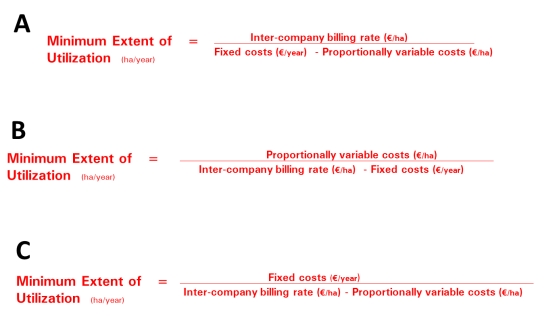
3.2.1: Minimum Extent of Utilization (MEU)
At what workload are the total costs of owning machinery just as high as the costs of external mechanization?

a. A
b. B
c. C
3.2.2: Minimum Extent of Utilization (MEU) Formula
a. A
b. B
c. C
3.3.1: To buy or to rent?
(A question of comparative cost and utilization)
3.3.2: To buy or to rent, comparative costs - MEU practice
a. the fixed costs per year are increasing
b. the total cost per year are decreasig
c. the fixed costs per hour are increasing
d. the average costs per hour are decreasing
4. Chapter
Chapter 4: Procedural costs – Opportunity costs
4.1: Procedural costs – Opportunity costs

4.2.1: Procedural costs "Precision Mulch Seed Drill" (PMSD)
basic data for the machinery cost (part 1a)
4.2.2: Procedural costs PMSD - Part 1b- solution
a. 207 ha
b. 200 ha
c. 167 ha
d. 187 ha
4.2.3: Procedural costs PMSD - Part 2a- solution
The machinery costs per hectare and year are ..............
b. 7 5.76 EUR / ha
c. 95.76 EUR / ha
d. 52.76 EUR / ha
4.2.4: Procedural costs PMSD - Part 2b- solution
(Please select)
4.3.1: Procedural costs mulcher, Example 1a
A. 2310 EUR / year
B. 2210 EUR / year
C. 2110 EUR / year
D. 2010 EUR / year
4.3.2: Procedural costs mulcher, Example 1b - solution
A. 60 ha
B. 270 ha
C. 180 ha
D. 90 ha
4.3.3: Procedural costs mulcher, Example 2a
A. 84.70 EUR / ha
B. 114.70 EUR / ha
C. 24.55 EUR / ha
D. 54.70 EUR / ha
4.3.4: Procedural costs mulcher, Example 2b- solution
A. 545 EUR / year
B. 1145 EUR / year
C. 945 EUR / year
D. 745 EUR / year
4.4: Discussion of the results
6. Examples
Chapter 6: Sample calculations
6.1: Sample calculations: Exercise for Combine Harvester
Calculation exercise "Combine harvester":
Part 1: Machinery costs
Part 2: Procedural costs
Part 3: Comparative costs and minimum extent of utilization at equal quality of work.
Part 4: Comparative costs and minimum extent of utilization at different quality of work.
6.1.1: Part 1a: Machinery costs,1a -task
The average costs per ha at an average use of 600 ha per year amount to....
A. 153,45 € per hectare
B. 84,33 € per hectare
C. 109,43 € per hectare
D. 72,56 € per hectare
6.1.2: Part 1b: Machinery costs,1b -solution
6.1.3: Part 2a: Procedural costs, 2a -task
A. 123,43 € per hectare
B. 130,32 € per hectare
C. 112,68 € per hectare
D. 117,83 € per hectare
6.1.4: Part 2b: Processing costs, 2b -solution
6.1.5: Part 3a: Comparison costs and Minimum Extent of Usage, 3a -task
A. 600 ha per year
B. 543 ha per year
C. 400 ha per year
D. 489 ha per year
6.1.6: Part 3b: Comparison of costs and minimum extent of utilization, 3b -solution
6.1.7: Part 4a:
Comparative costs and minimum extent of utilization, taking into account differences in the quality of work - Exercise 1, 4a -task
A. 418,8 ha per year
B. 600 ha per year
C. 350 ha per year
D. 400 ha per year
6.1.8: Part 4b: MEU with differences in the quality of work, 4b -solution 1 and task 2
The minimum extent of utilization in hectares per year for the owned harvesters, under consideration of higher yield losses due to internal mechanization
A. 592,5 ha per year
B. 600 ha per year
C. 489 ha per year
D. 543 ha per year
6.1.9: Part 4c: MEU with differences in the quality of work, 4c -solution
The correct answer is: The minimum extent of utilization for an owned harvester, taking into account the higher losses on the side of internal mechanization, is 592.5 ha per year. Accounting for both effects simultaneously, the minimum workload is only at 447.6 ha per year.
7. Summary
8. Skripts
Chapter 7: Script | Glossary | Calculator of operational costs of agricultural machinery
7.1: Script

7.2: Glossary


7.3: Calculator of operational costs of agricultural machinery


9. Content
MOOC 1_EN: The agricultural machinery costs calculation
Content:
| Topic 1 | Introduction to the course and the topics | |
| 1.1 | Economics | |
| 1.2 | Farmers Boris and Alexander have a problem! | |
| 1.3 | Why Economics? | |
| Topic 2 | Introductin costs and explanation of fixed and variable costs |
|
| 2.1 | What are costs? | |
| 2.2 | Act of purchase | |
| 2.3.1 | Fixed and variable costs | |
| 2.3.2 | Change in costs during expansion or restriction of production | |
| 2.4 | Overhead costs and special costs | |
| 2.5 | Depreciation | |
| 2.6 | Financing costs | |
| 2.6.1 | Financing costs without residual value | |
| 2.6.2 | Financing costs with residual value | |
| 2.7 | Insurance, motor vehicle tax, TÜ costs | |
| 2.8 | Accommodation costs | |
| 2.9 | Variable machinery costs | |
| 2.10 | Repair costs | |
| 2.11 | Exkursus: Fixed assets and current assets | |
| Topic 3 | Summary of machinery costs ( average-, marginal-, total costs) | |
| 3.1 | Total costs, average costs | |
| 3.2.1 | Minimum Extent of Utilization (MEU) | |
| 3.2.2 | Minimum Extent of Utilization (MEU) Formula | |
| 3.3.1 | To buy or to rent? | |
| 3.3.2 | To buy or to rent, comparative costs - MEU practice | |
| Topic 4 | Procedural costs – Opportunity costs | |
| 4.1.1 | Procedural costs – Opportunity costs, Part 1 | |
| 4.1.2 | Procedural costs – Opportunity costs, Part 2 | |
| 4.2.1 | Procedural costs "Precision Mulch Seed Drill" (PMSD) basic data for the machinery cost | |
| 4.2.2 | Procedural costs PMSD - Part 1 | |
| 4.2.3 | Procedural costs PMSD, Example Part 2a | |
| 4.2.4 | Procedural costs PMSD - Part 2b- solution | |
| 4.3.1 | Procedural costs mulcher, Example 1a | |
| 4.3.2 | Procedural costs mulcher, Example 1b | |
| 4.3.3 | Procedural costs mulcher, Example 2a | |
| 4.3.4 | Procedural costs mulcher, Example 2b | |
| 4.4 | Discussion of the results | |
| Topic 5 | Comparative costs and Minimum Extent of Utilization (MEU) | |
| 5.1 | Comparative costs | |
| 5.2 | Minimum Extent of Utilization (MEU), Formula | |
| Topic 6 | Exercises | |
| 6.1 | Exercise Combine Harvester | |
| 6.1.1 | Part 1a: machinery costs,Tasks | |
| 6.1.2 | Part 1b: machinery costs, Solution | |
| 6.1.3 | Part 2a: Procedural costs, Tasks | |
| 6.1.4 | Part 2b: Processing costs - Solution, | |
| 6.1.5 | Part 3a: Comparison costs and Minimum Extent of Usage, Tasks | |
| 6.1.6 | Part 3b: Comparison of costs and minimum extent of utilization - Solution | |
| 6.1.7 | Part 4a: Comparative costs and minimum extent of utilization, taking into account differences in the quality of work - Exercise 1, Tasks | |
| 6.1.8 | Part 4b: MEU with differences in the quality of work - Solution 1 and task 2 | |
| 6.1.9 | Part 4c: MEU with differences in the quality of work - Solution 2 | |
| 6.2.1 | Exercise "Square baler", Part 1a: Machinery costs, Tasks |
|
| 6.2.2 | Part 1a: Machinery costs, Solution | |
| 6.2.3 | Part 2a: Procedural costs, Tasks | |
| 6.2.4 | Part 2a: Procedural costs, Solution | |
| 6.2.5 | Part 3a: Comparative costs and minimum extent of utilization at equal quality of work | |
| 6.2.6 | Part 3b: Costs of own machinery | |
| Topic 7 | Summary | |
| Exam | Final Exam | |
| Curs End |