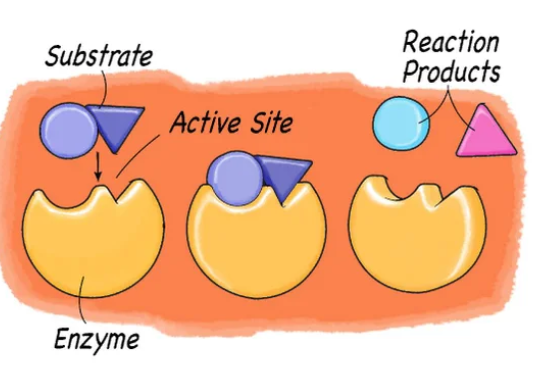
Enzymes are proteins composed of long amino acids chains. In food they act as catalysts for chemical reactions, which accelerate many flavor, color, texture, and nutritional changes, especially when food is cut, sliced, crushed, bruised, and exposed to air. Enzyme activities are sometimes wanted e.g. in fermentation processes. In other cases they lead to unwanted break-down or discoloration of foods.
Enzymes can be quite sustrate specific. This depends on the part of the enzyme where
the specific substrate binds to react. This part of the enzyme is called the active site.
An enzyme reaction follows 4 stages:
Diffusion of the substrate towards the active site
Binding of the substrate to the active site
Reaction of the substrate to form the new product
Diffusion of the product away from the active site
In some reactions, one substrate molecule
breaks to form multiple products, in others, two substrate
molecules join to form one large molecule.
The enzyme remains unaltered at the end of the reaction and thus is free
to bind another substrate and catalyze a new reaction.
Enzymes work by lowering the activation energy – the amount of energy
needed for the reaction to begin. Enzymes work by binding to reactant
molecules, holding them so that the formation and breaking of bonds
during the process can take place readily.
To be able to do this some enzymes require a non-protein part, known as cofactors.
There are three types of cofactors:
Prosthetic Groups: They remain tightly bound to an enzyme all the time, e.g. FAD (FAD +2H+ +2e- --> FADH2)
Coenzyme: They bind to an enzyme only during catalysis, e.g. NAD+ (NAD+ + 2H+ + 2e- --> NADH + H+)
Metal Ions: Certain enzymes require a metal ion
bonded at their active site for catalysis, e.g. Zn2+ or Cu2+
The activity of an enzyme is expressed in units (U), whereby 1 U = 1µmol subtrate turnover/min
Their activity can be influenced by their own concentration the substrate concentration, temperature changes, and presence of inhibitors. Enzymes can be denaturated by heat treatment (e.g. blanching, canning, freezing, etc.) or pH-changes.
Enzymes are categorized following the Enzyme Commision nomenclature for enzymes (EC numbers):
Each enzyme is described by "EC" followed by a sequence of four numbers
which represent the hierarchy of enzymatic activity (from very general
to very specific).