
Glossary
Not
every single piece of interesting or useful information can be
contained in the lectures of this course. The digital format of this
course however, makes it easy to provide and link extra information in a
glossary. We hope you enjoy reading through the glossary entries and
make good use of the treasures we have 'hidden' here.
Special | A | B | C | D | E | F | G | H | I | J | K | L | M | N | O | P | Q | R | S | T | U | V | W | X | Y | Z | ALL
S
SanitizationIt is important to differentiate and define certain terminology:
Appropriate and approved sanitization procedures are processes, and, thus, the duration or time as well as the chemical conditions must be described. The official definition (Association of Official Analytical Chemists) of sanitizing for food product contact surfaces is a process which reduces the contamination level by 99.999% (5 logs) in 30 sec. The official definition for non-product contact surfaces requires a contamination reduction of 99.9% (3 logs). The standard test organisms used are Staphylococcus aureus and Escherichia coli. General types of sanitization include the following:
| ||
Saturated and Unsaturated FatsFats are called saturated fats, if the number of saturated fatty acids, which make up the fat is bigger than the number of unsaturated fatty acids, and vice versa, fats are called unsaturated fats, when they contain more unsaturated fatty acids than saturated ones. Saturated fats are usually soild at room temperature, like e.g. butter, lard, or coconut oil. Saturated fats are associated with high cholesterol levels, which can contribute to heart disease. Unsaturated fats are usually liquid at room temperature, like vegetable oils. Sources of monounsaturated fats are olive oil, peanut oil, canola oil, avocados, and most nuts, as well as high-oleic safflower and sunflower oils. Polyunsaturated fats are essential fats, which means they are needed for body functions, but cannot be made by the body itself. They have to be taken in with food. The two main types of polyunsaturated fats are omega-3 fatty acids and omega-6 fatty acids. The numbers refer to the number of the carbon atom of the first double bound, counted from the methyl end. Sources of omega-3 fatty acids include fatty fish such as salmon, mackerel, and sardines, flaxseeds, walnuts, canola oil, and un-hydrogenated soybean oil. Sources of omega-6 fatty acids include vegetable oils such as safflower, soybean, sunflower, walnut, and corn oils. Most diets are low in omega-3 fatty acids and high in either saturated, hydrogenated or omega-6 fatty acids. These imbalances can have negative health impacts. Replacing saturated fats in the diet with polyunsaturated fats, and especially omega-3 fatty acids, is recommended. See also: Fatty acids | |
ScalabilityThe ability of a business to grow fast without increasing its production costs. | |
Secondary food processingThe conversion of ingredients into edible products. This process involves combining foods in a particular way to change its properties, for example, heating cake batter to form a cake. | |
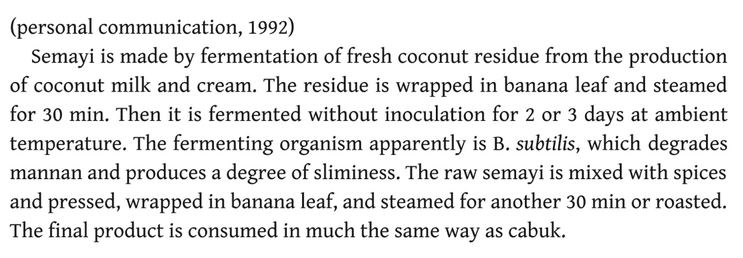
Semayi
Source: Handbook of Indigenous Fermented Foods, Revised and Expanded, by Keith Steinkraus | |
Sensory propertiesThe characteristics of food that encompass the senses, such as appearance, texture, aroma, flavour, sound. | |
Series A, B, and C fundingSeries A and B refer to the first and second rounds of significant
funding that a start-up receives, typically from a venture capital firm.
Series C is the third round of funding, meant for established start-ups
in the later stages of their growth. | |
Series A (funding)The name given to the first round of significant financing a start-up receives from a venture capital firm. This round of funding is typically to cover salaries, additional market research and to finalise the product or service to be brought to market. See also Series B. | |
Series BThe name given to the second round of significant financing and will typically range between 1 million and 30 million USD. | |