
The role of accounting in Management

3. Petty Cash
In some countries businesses still make a large number of payments in cash. In many cases also a number of persons is tasked with cash purchases of different kinds. Petty Cash Vouchers as well as handwritten receipts can be common. Tracing cash advances and payment receipts is a major accounting task in such operations. It is useful to print a petty cash voucher book that allows for easy tracing and balance reconciliation.
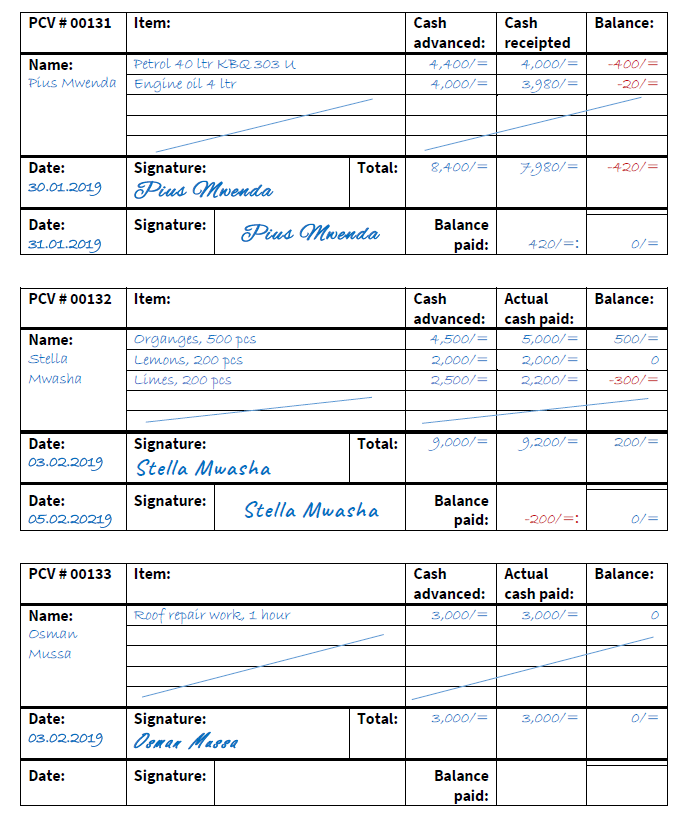
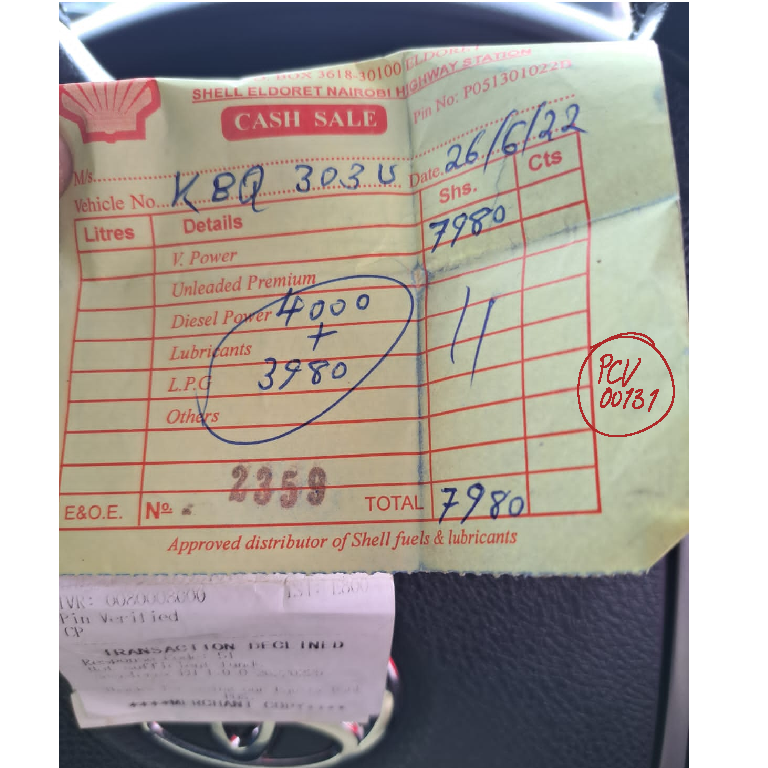
In the example above the person receiving a cash advance signs for the amount received and once the purchase is made returns the receipt(s) for the purchase. These are recorded on the same voucher and the balance payable or receivable is recorded. Once the balance is paid the person signs for it on the same voucher again and it is easily visible that the transaction was reconciled. In this way outstanding receipts and balances can be followed-up easily. The receipt is marked with the Petty Cash Voucher (PCV) number and filed in either numerical order, by date or by category. With this number it can always be easily traced back to the original cash transaction. This petty cash book or cash register should be accompanied with a daily cash log, where all cash in/out transactions for the day are recorded to check if the cash balance at the end of the day is correct. Printable templates can be found here under resources of this lesson. If for example an imprest of 500$ was received by the person handling the petty cash, at the end of the day the remaining cash balance plus the reicepted amounts must still add up to 500$.
Where mobile money options are available these are preferable to petty cash transactions as payments can be made to the exact amount (reducing the need for follow up on outstanding balances), and each transaction creates a digital receipt that is automatically recorded on a printable monthly ledger for mobile money transactions.