
Microorganisms in food

2. Cause of foodborne illnesses - a data review
According to a data review conducted by the FDA in 2015, viral pathogens
account for an estimated 5.5 million foodborne illnesses each year, with
norovirus responsible for most foodborne illnesses on an annual basis
(58%) (Scallan et al., 2011).
Among
the bacterial pathogens causing foodborne illnesses, the three most
common are Salmonella spp. (11%), Clostridium perfringens (10%) and
Campylobacter spp. (9%) (Scallan et al., 2011). Other bacterial
pathogens causing relatively large numbers of illness include Bacillus
cereus, E. coli O157:H7, non-O157 Shiga-toxin producing E. coli,
Shigella spp., Staphylococcus aureus, and Yersinia enterocolitica
(Scallan et al., 2011).
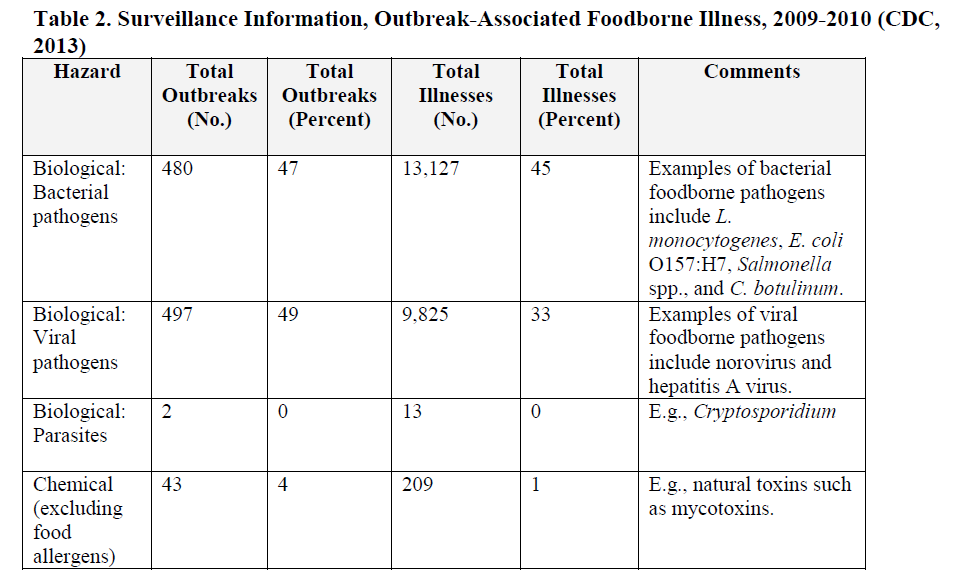
Source: Center for Food Safety and Applied Nutrition, Food and Drug Administration, U.S. Department of Health and Human Services, "Qualitative Risk Assessment: Risk of Activity/Food Combinations for Activities (Outside the Farm Definition) Conducted in a Facility Co-Located on a Farm", 2015