
Microorganisms in food

6. Biofilm creation
Bacteria have the ability to form a biofilm that provides protection from commonly encountered environmental stresses like temperature changes, drying out, and even cleaning measures like scrubbing and use of detergents or sanitizers. Once pathogenic bacteria attach to and accumulate on equipment and surfaces and form biofilms they also have a significantly increased resistance to antimicrobials. This ability makes the existence of harmful bacteria in food processing environments very dangerous. Very likely more than half of all foodborne illnesses are caused by bacterial biofilms. Foodborne pathogens like Salmonella sp., Listeria monocytogenes, Campylobacter jejuni, Escherichia coli O157: H7, Yersinia enterocolitica and Staphylococcus spp. have been reported to form a biofilm in food processing facilities.
Bacterial biofilm formation is a series of dynamic steps, comprised of initial attachment, irreversible attachment, biofilm development, biofilm maturation, and biofilm dispersion. Once bacteria attach to a surface the cells are overlaid by a conditioning film comprising of a small quantity of polysaccharides, proteins, and phospholipids. The attached bacteria continue to produce a polysaccharide to form a microcolony which matures into a biofilm. During the maturation process secreted extracellular polymeric substances (EPS ) help strengthen the bond between the bacteria to stabilize the colony and protect it from any hostile environment. Once the biofilm is formed, bacteria can survive even under very unfavorable conditions. During biofilm maturation, the bacteria develop into an organized flat or mushroom-shaped structure. The final step is a dispersion of the biofilm.
The initial attachment of bacteria to a surface is reversible and the bacterial cells still detach easily. However, the more EPS is produced, the adhesion of the bacterial changes from reversible to irreversible. During this step, the originally weak contact forces change to tight bonding.
The attached material properties and environment (pH, temperature, and nutrients) have an affect on the formation and early development of a biofilm and it is therefore crucial to control and eliminate the formation of biofilms from the start. Frequent meachanical cleaning, like scrubbing with detergents, rinsing with hot water, wiping off residues, etc. can assist in preventing biofilm formation from the start. However, mechanical treatment alone, such as cleaning, cannot remove all bacterial cells and needs to be combined with chemical treatments such as the use of sodium hypochlorite (NaClO) to adequately eliminate bacterial cells and inhibit biofilm formation.
Various other methods have been developed from different aspects, such as inhibition of bacterial adhesion and bacterial detection in the early stage, as well as dissolving the biofilm. New strategies involve biochemical agents including clove and thyme essential oils, enzymes, biosurfactants, and others for “green” approaches to control pathogen biofilms formation.
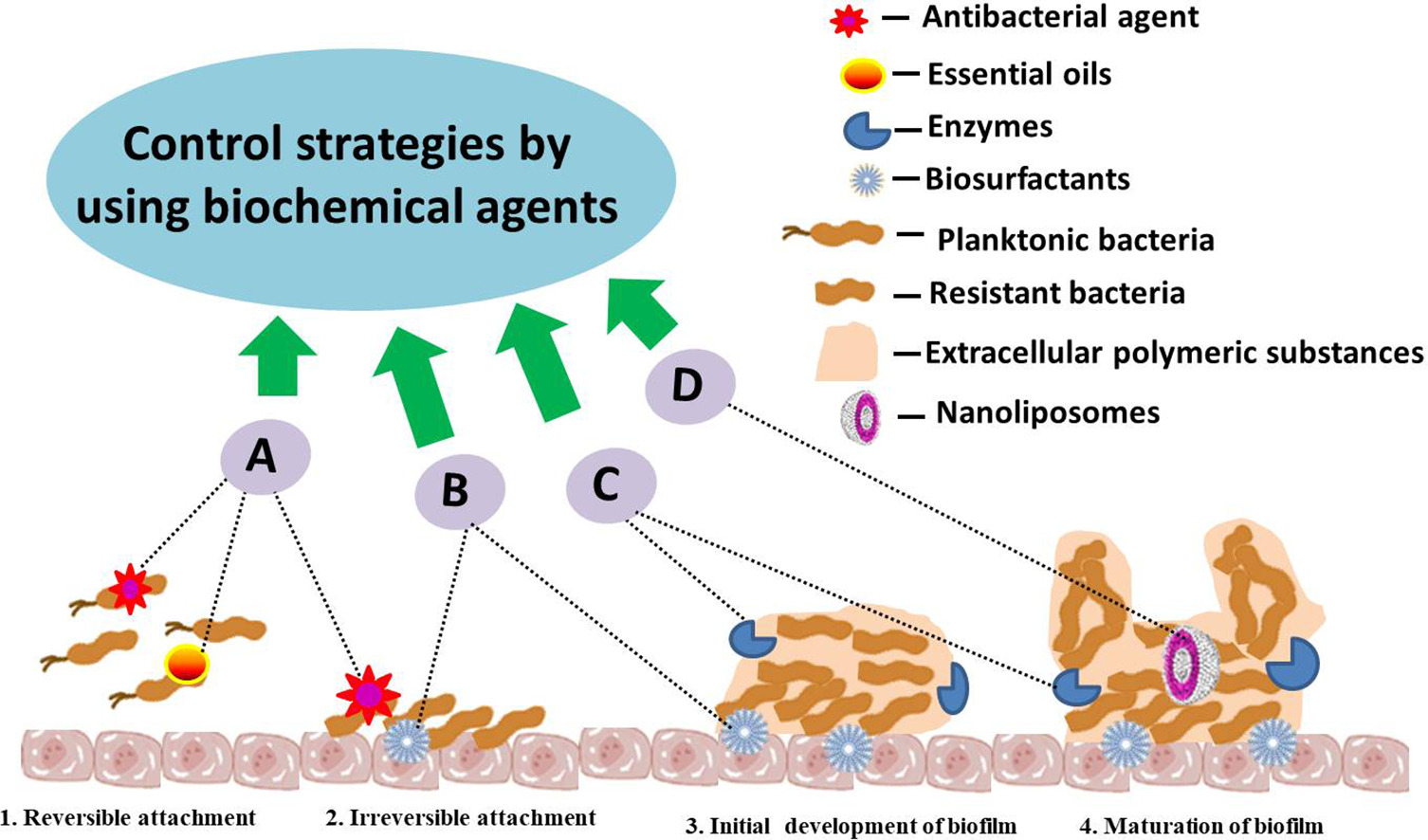
Image source: Tingwei Zhu, et al, Strategies for controlling biofilm formation in food industry, Grain & Oil Science and Technology, Volume 5, Issue 4, 2022,
Find some new research from Wageningne Universtity about 'How Listeria Strains Evolve Into Strong Biofilm Formers' here.