
Glossary
Not
every single piece of interesting or useful information can be
contained in the lectures of this course. The digital format of this
course however, makes it easy to provide and link extra information in a
glossary. We hope you enjoy reading through the glossary entries and
make good use of the treasures we have 'hidden' here.
Special | A | B | C | D | E | F | G | H | I | J | K | L | M | N | O | P | Q | R | S | T | U | V | W | X | Y | Z | ALL
D
Dawa dawaDawadawa is a West African condiment and meat substitute made from fermented locus bean (Parkia biglobosa). In Benin fermented locust beans are called sumbala. Watch a video showing the process of making dawa dawa here:
| ||
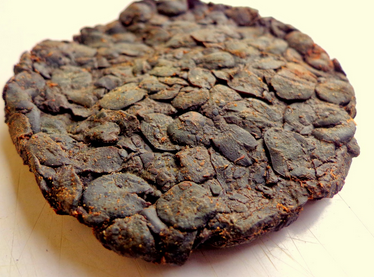
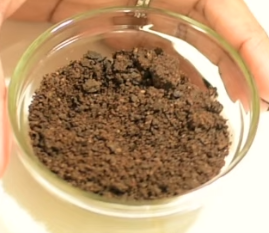

Decimal scale
kilo means x1000. In units of length it espressed as: km and in units of weight it is expressed as: kg 1km = 1000m or 1x10³m, and 1 kg = 1000g or 1x10³g centi means 1/100th. In units of length it is expressed as: cm (centimeter) 1cm = 1/100th of a meter, also written as: 1x10 -2 m or: 100 cm = 1m milli means 1/1000th. In units of length is is expressed as: mm (millimeter). In units of weight it is expressed as: mg (milligram) 1mm = 1/1000th of a meter, also written as: 1x10⁻³m. Also: 1000mm = 1m 1mm = 1/10th of a centimeter, also written as: 1x10⁻¹cm. Also: 10mm = 1cm 1mg = 1/1000th of a g, also written as: 1x10⁻³g micro means 1/1000 000th. In units of length it is expressed as: µm (micrometer) 1µm = 1/1000 000th of a meter, also written as 1x10⁻⁶m. Bacteria are in the size range of 1µm. A typical human cell (as well as animal and plant cells) has a diameter of 10-20µm. A human hair has a diameter of about 100µm. The size of objects inside a cell is measured in nano meters (nm). nano means 1/1000 000 000th. In units of length is is expressed as: nm (nanometer) 1nm = 1/1000 000 000th of a meter, also written as 1x10⁻⁹m. Many molecules are in the size range of 1nm, while viruses are about 100nm accross. | |
DeficiencyThe lack of essential nutrients leading to malnutrition and disease | |
DeformationA process where the shape of an object is altered | |
Demographic groupA population subset with similar characteristics, such as socio-economic state, age, education level, ethnicity. | |
DenaturationBecause the 3D structure of proteins is caused by many different, sometimes very weak interactions, proteins are very stress-sensitive. Their structure in its native state can be distroyed - we say denatured - by temperature, pH, removal of water, presence of hydrophobic surfaces, presence of metal ions and high shear, etc. When a protein is denatutred its complex 3D structure unfolds and takes on another shape. Denatured proteins have very different properties from their original native state. Heat e.g causes the egg white’s proteins to denature and coagulate, resulting in the formation of a solid mass. If an acid, like lemon juice or vinegar is added to milk, the protein casein denatures and coagulates, forming curds. In food processing denaturation can be desired, as in the examples above, or as described in the Maillard reaction, where proteins react with carbons if exposed to heat and produce a delicious crust on baked or fried goods. In some cases however, denaturation can also lead to unwanted changes in texture and flavor. Frozen eggs or dairy products e.g. become lumpy and unpalatable when thawed as a result of denatured proteins. Understanding the science behind protein denaturation is therefore important for successfull food processing. While the tertiary and secondary structure of proteins, which depends on hydrogen or ionic bonds and hydrophobic interactions, is broken up during denaturation, the primary structure, which is made up of covalent peptide bonds, is not altered. These peptide bonds therefore play an important role in protein stability. When the protein is denatured, it unfolds, but the amino acid sequence remains the same. This leads to the fact, that denatured proteins can in some cases return from their denautred, unfolded state back to their original state. This usually depends on the type and intensity of the denaturing stress. An eggwhite e.g. gets temporarily denatured when whipped into egg white foam, but liquifies again if left to stand for a while (reversibly denatured). An egg white that has been denatured by hot temperatures during boiling, coagulates by coiling up, a state that cannot be reversed (irreversibly denatured). The egg white foam, even if it liquifies again, will not return 100% to its original state. Part of it will remain denautered. Beating an egg white foam a second time therefore never works as well as the first time. See also: Heat denaturation and acid denaturation. | |
DensityA physical property; relationship between mass and how much space
(volume) it takes up. An indication of how open the internal structure
is. | |
DepreciationDepreciation is the accounting method used to spread out the cost of an asset over a period of time, thereby reducing the cost of the asset in the current period. This reflects the loss of value over time of a used item. After the depreciation of an asset it often still has a residual value, meaning it can still be sold for a certain amount after its book value has been written off. It can be calculated as follows: Depreciation = (cost of asset - salvage value)/projected years of use. Diminution of assets, value adjustments, and depreciation are all forms of internal financing that allow a business to free up capital by reducing the value of its assets, or its inventory. Examples for depreciation rates are:
Land is never depreciated. | ||||||||||||||||||||||||||||
Desk ResearchUsing existing written data to gain further understanding in a particular subject. | |