Requirements for food labels

1. Regulations and standards
Labels on packaged food have to follow certain regulations and standards. These regulations and standards however, are different for each country, although all follow more or less the Codex Alimentarius, which is a guideline for global standardization. In accordance with food laws, labels must tell the truth and manufacturers must not represent foods in a false, misleading or deceptive way.
The label must be clear and easy to read, permanent, easy to understand, easily visible, and not misleading.
To be internationally acceptable, the label must include the following information:
Food package labels must include a name or a description of the food. This name or description should be clear enough so you can tell it apart from other foods. If there is a prescribed name for the food in the Food Standards Code this must be included on the label. If there is no prescribed name for a food, the label must include a name or description that clearly states the true nature of the food.
The 'Best Before' or 'use by/Expiry' date
Net quantity information (more details can be found here)
Business name and address (mandatory in most countries
Any necessary warnings (e.g. allergens in bold letters, additives that may have a harmful impact, like Aspartame: ‘Contains a source of phenylalanine’, or special storage conditions and/or conditions of or instructions for use.
The country or place of origin, usually required for products sold in retail settings, and mandatory for export. It is also often required if the name of the product implies a certain place of origin, but it is produced in another country or a main ingredient is imported from another country than indicated in the name. E.g. if the name is 'German Rye Bread' but it was baked in Kenya, or the name is 'Uganda Coffee' but it is mixed with coffee beans from Ethiopia and Kenya.
The lot number, important for batch identification in re-call scenarios (in smaller production can be replaced by the production/manufacturing date)
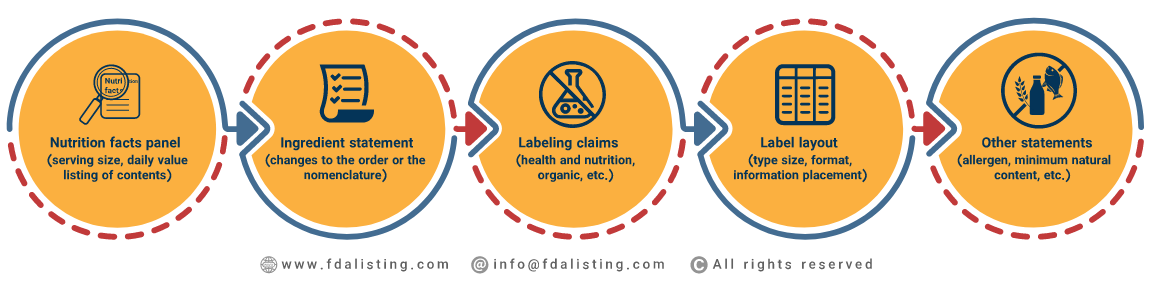
Nutritional information or quantity of certain categories of ingredients (salt, saturated fats, sugar). If your product claims to be gluten free the nutrition panel must include the line 'gluten less than 3ppm'. If your product claims to be rich in Vit.C e.g this needs to be quantified in the nutrition panel. Regulations vary from country to country and you should inform yourself before entering a certain market. Nutritional information may also have to include the serving size and percentage of daily value.
In case of alcoholic beverages with an alcohol content of above 1,2 % by volume of alcohol, the actual alcoholic strength by volume has to be declared.