
Glossary
Not
every single piece of interesting or useful information can be
contained in the lectures of this course. The digital format of this
course however, makes it easy to provide and link extra information in a
glossary. We hope you enjoy reading through the glossary entries and
make good use of the treasures we have 'hidden' here.
Special | A | B | C | D | E | F | G | H | I | J | K | L | M | N | O | P | Q | R | S | T | U | V | W | X | Y | Z | ALL
L
Landing PageA simple webpage that is designed to lead the visitor to your website, normally linked to paid advertisement on google, social media, etc. | |
LaunchWhen a business strategically releases a new product or service into the
public market, making it officially available for purchase. | |
Leafy vegetablesLeafy vegetables or leafy greens are plants that are eaten for their leaves. Around 1000 different plants are known to have edible leaves. Common leafy greens in the Western world are kale and collard greens, spinach, swiss chard, different lettuces, different types of cabbages, celery, and a large number of leafy herbs. Traditionally also eaten were wild plants like dandelion, shepard's purse, stinging nettle, and water cress. Lesser known leafy greens include mustard leaves, rape , radish and beet leaves, sorrel, malaba spinach and new zealand spinach. In Mexico foraged leafy greens are referred to as quelite. In India mustard greens, fenugreek leaf (methi), leaves of okra, bitter gourd, bottle gourd etc. are very widely used in daily cuisine. The Asian kitchen knows a huge number of different leafy vegetables and salad greens, some of which are flower shoots, like edible crysanthemum or Ma lan tou (Kalimeris indica). A good description of many Chinese uses of leafy greens can be found here: https://thewoksoflife.com/chinese-ingredients-glossary/chinese-vegetables-asian-leafy-greens/ Africa also has a long list of traditionally used leafy greens, which are served with almost every meal. Many of these wild-collected greens are still common and even commercially available.
Examples of traditional African leafy vegetables:
a) purple amaranth (Amaranthus cruenthus),
b) jute mallow (Corchorus olitorius), c) roselle (Hibiscus subdariffa) Jute mallow is known as delele in Zambia and Botswana, murere in Kenya, derere in Zimbabwe, and molokhia in North Africa. d) African eggplant (Solanum macrocarpon), e) waterleaf or Ceylon spinach (Talinum triangulare)
and f) cocoyam (Xanthosoma sagittifolium) Cocoyam (taro) leaves are used to prepare palaver sauce in Ghana, while in Francophone Africa, cocoyam leaf stew is referred to as sauce feuilles. 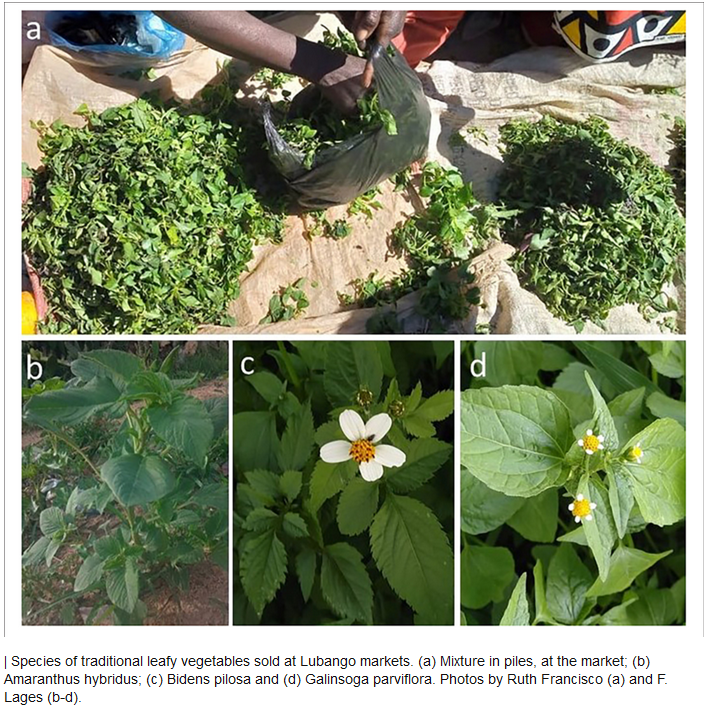 Amaranth leaves of many different spiecies, like: A. blitum, A. caudatus, A. cruentus, A. dubius, A. gangeticus, A. polygonoides, A. roxburghianus, A. spinosus, A. tricolor, or A. viridis, are known as mchicha in Tanzania, mowa in Zimbabwe, umfino in South Africa, bonongwe in Zambia and Malawi, efo tete in Nigeria, and alefu in Ghana. Other edible green leaf plants closely related to Amaranth are: 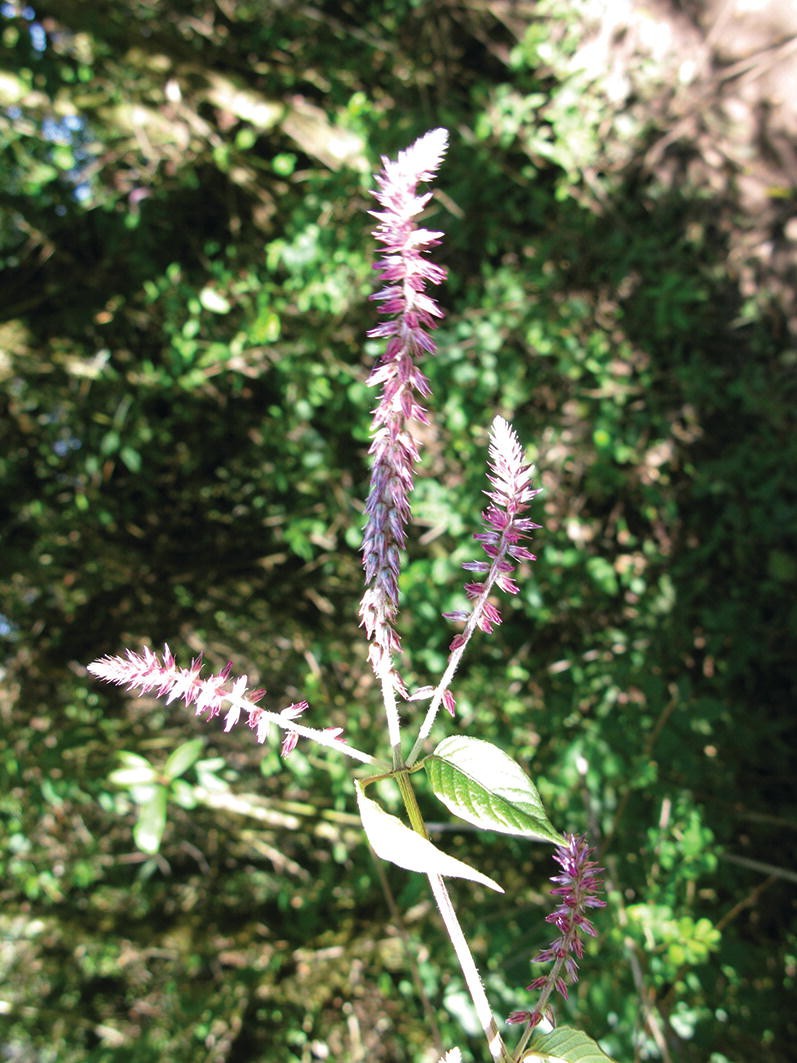 Achyranthes aspera: in Luo: Auch-Auch; Turu: Inyalo; Hehe: Lugeni; Luhya: Lusayi; Swahili: Pulule; Kamba: Uthekethe (Kokwaro 2009). Achyranthes aspera: in Luo: Auch-Auch; Turu: Inyalo; Hehe: Lugeni; Luhya: Lusayi; Swahili: Pulule; Kamba: Uthekethe (Kokwaro 2009).and the very similar Celosia argentea var. argentea or Lagos spinach is one of the main boiled greens in West Africa, where it is known as soko yòkòtò (Yoruba) or farar áláyyafó (Hausa). 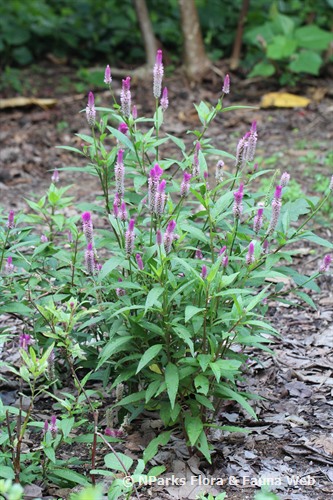 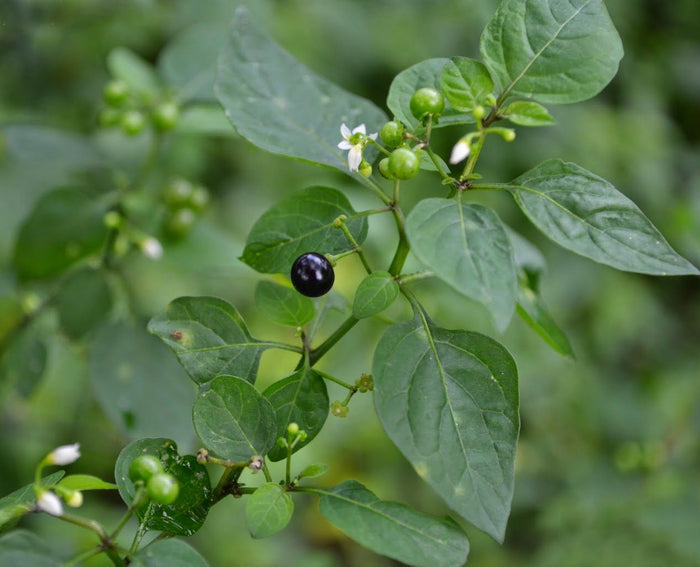 Species known as African nightshade include Solanum scabrum, S. villosum, S. nigrum, and S. americanum.[1] Local East Afrikan names of African nightshade include managu (Kikuyu), mnavu (Swahili), rinagu (Kisii), tsisutsa (Luhya), osuga (Luo), isoiyot (Kipsigis), kitulu (Kamba), ormomoi (Maa), ndunda (Taita), nsugga (Luganda), sochot (Keiyo), and esisogho (Lukhonzo). In Cameroon the Nso people call it Nyuuseji, and the Kom people call it Mbasi Species known as African nightshade include Solanum scabrum, S. villosum, S. nigrum, and S. americanum.[1] Local East Afrikan names of African nightshade include managu (Kikuyu), mnavu (Swahili), rinagu (Kisii), tsisutsa (Luhya), osuga (Luo), isoiyot (Kipsigis), kitulu (Kamba), ormomoi (Maa), ndunda (Taita), nsugga (Luganda), sochot (Keiyo), and esisogho (Lukhonzo). In Cameroon the Nso people call it Nyuuseji, and the Kom people call it Mbasi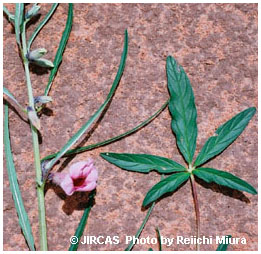 Winged-Seed Sesame (Sesamum alatum) also Guzozo in Shona (Zimbabwe) and hansi lamti or hansi foy in Zarma (Western Niger) Winged-Seed Sesame (Sesamum alatum) also Guzozo in Shona (Zimbabwe) and hansi lamti or hansi foy in Zarma (Western Niger) ______________________________________________________________________________________________________________________________________________________________________________________ (1) Drescher, A. W.; Pasquini, M. W.; Shackleton, C. M. (2009). "African Indigenous Vegetables in Urban Agriculture". Earthscan. ISBN 9781136574986. Retrieved November 14, 2013. | |||
:max_bytes(150000):strip_icc():format(webp)/GettyImages-590213132-c2d457c7ae23499ea7ad41807ed50774.jpg) Cassava (Manihot esculenta) leaves are used as a spinach called kisamvu in the Swahili kitchen, as
Cassava (Manihot esculenta) leaves are used as a spinach called kisamvu in the Swahili kitchen, as
LeanIdentifying how to create more value for customers with less resources. | |
LeaveningWith the application of mechanical actions, an agent is added to a food product, such as a dough or batter to cause baked goods to rise. Usually an acid is added to an alkali or a biological agent is used and when heated in the presence of moisture a gas is produced. This causes expansion of mixtures and baking produces products with porous structures. Agents could include mechanical incorporation of air, steam, yeast, baking powder and baking soda. | |
Leavening agentsLeavening agents are ingredients that are used in baking to make dough or batter rise. This is done by making carbon dioxide gas, which causes the dough or batter to expand. This makes the dough or batters lighter and fluffier. There are many different kinds of leavening agents, such as:
Cakes, muffins, biscuits, bread, and pizza dough are all baked goods that need leavening agents. | |
LeverageFinancial leverage, also known as the equity multiplier, refers to the use of debt to buy assets. If all the assets are financed by equity, the multiplier is 1. As debt increases, the multiplier increases from 1, demonstrating the leverage impact of the debt and, ultimately, increasing the business risk.
Sourcer: https://online.hbs.edu/Documents/managers-guide-to-finance-and-accounting.pdf | |

LiabilitiesLiabilities are legally binding obligations
that are payable to another person or entity. Settlement of a liability
can be accomplished through the transfer of money, goods, or services. A
liability is increased in the accounting records with a credit and decreased with a debit.
A liability can be considered a source of funds, since an amount owed
to a third party is essentially borrowed cash that can then be used to
support the asset base of a business. Examples of liabilities are accounts payable, accrued liabilities, deferred revenue, interest payable, notes payable, taxes payable, and wages payable. | |
Limited liability company (LLC)A hybrid entity involving a strategic alliance that combines the
characteristics of a corporation and a partnership or sole
proprietorship. LLCs benefit from the flexible taxation of partnerships
and sole proprietorships, but they maintain the limited liability status
of corporations. This protects the business owners from personal
responsibility for the company’s debts or liabilities. | |